SCOTCAT.COM
your internet guide to all things catfish
FACTSHEETS: April 2020 - no. 286
Tachysurus gracilis (Li, Chen & Chan, 2005) |
|
Tachysurus
gracilis There is still
ongoing discussions in the scientific fraternity on
the validity of the genus name of Tachysurus
as the original description of this genera was by
La Cepède in 1803 and it depicted a member
of the Ariid catfish family. He proposed the name
Tachysurus sinensis for a catfish depicted
in a Chinese illustration archived in Paris at the
Muséum National d’Histoire Naturelle
(MNHN). Tachysurus sinensis La Cepède,
1803 is the type species of Tachysurus La
Cepède, 1803 (pp. 150, 151) by monotypy. The
locality for the illustration is given as China. The
only problem with this was the painting looked very
much like a Bagrid and not an Ariid species and quite
probably Pseudobagrus fulvidraco (Richardson,
1846) or P. nitidus Sauvage & Dabry de
Thiersant, 1874.
Tachysurus
gracilis
|
 ne look at our factsheet of the month for April 2020
and you may think that this fish needs a good feed
but as its specific name suggests, gracilis: meaning
graceful or slender, and you get the exact nature
of this catfish from the Bagridae family and why it
looks like this. T. gracilis was described
from specimens collected from the Zhujiang (Pearl
River) basin, southern China.
ne look at our factsheet of the month for April 2020
and you may think that this fish needs a good feed
but as its specific name suggests, gracilis: meaning
graceful or slender, and you get the exact nature
of this catfish from the Bagridae family and why it
looks like this. T. gracilis was described
from specimens collected from the Zhujiang (Pearl
River) basin, southern China.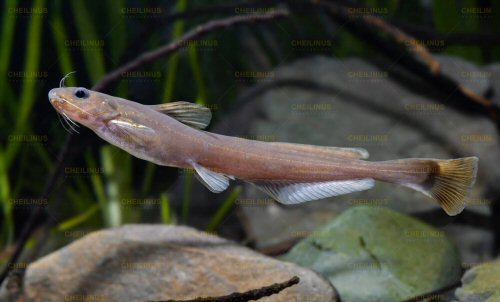
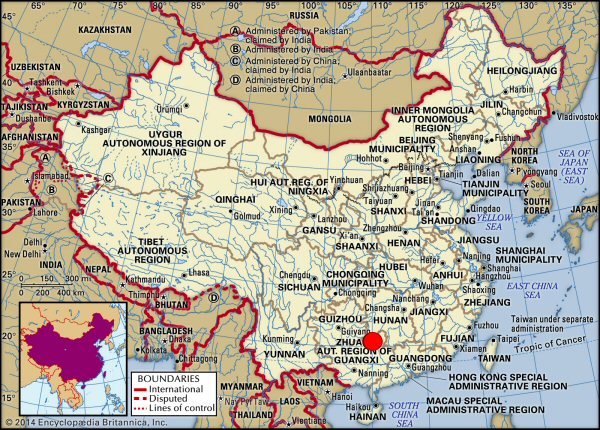
Type locality: China: Guangxi Province, Guilin City, Zhujiang basin, Lijiang drainage, 29º55'23 N, 118º28'12 E. |
Above are the caudal shapes of five species of Tachysurus as depicted by Jie Li, Xianglin Chen & Bosco P.L. Chan; (2005) and in the paper as Pseudobagrus. (1) T. gracilis (2) T. pratti (3) T. tenuis (4) T. ussuriensis (5) T. adiposalis.
|

Synonyms |
Pseudobagrus gracilis |
Common Name |
None |
Family |
Bagridae |
Subfamily |
- |
Distribution |
Asia: Beijiang and Xijiang (West River) River basins, southern China. Type locality: China: Guangxi Province, Guilin City, Zhujiang basin, Lijiang drainage, 29º55'23 N, 118º28'12 E. |
Size |
17cm (6¾ins) |
Temp. |
21-24°C (69-75°F) |
p.H. |
6.0-7.0. |
Characteristics |
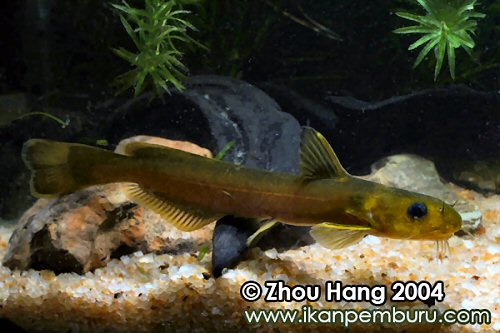
Large elliptical eye (19.8–24.4% HL), a short maxillary barbel not reaching the posterior margin of the eye, a lightly serrated posterior edge on the second dorsal spine, a caudal fin slightly emarginated with upper lobe slighter longer than lower lobe, frontal concave with a smooth surface, and supraoccipital process short (far from the first basal bone of the dorsal spine). |
Colouration |
The dorsum is dark grey, and the underside is whitish with yellow in all fins in some specimens. Alcohol-preserved specimens are greyish-brown dorsally, and flanks have a lighter tinge. |
Aquarium Care & Compatibility |
| This is a primarily a cool water catfish so placing the tank in a centrally heated house would suffice but there are also reports that this catfish is also happy at temperatures of between 23-26°C (72-79°F) so a very variable temperature range does not worry this Bagrid at all. Providing a good current in the aquarium will suit this catfish. Not too much of a problem catfish as long as you don't house them with smaller species as being a Bagrid they will do what the vast majority of Bagrids will do "chase and eat them". Keep them in a group and they will get on fine together as long as you give them plenty of room and hiding places for each individual. |
Reproduction |
In their natural habitat these fish form small breeding colonies by making burrows or depressions on the bottom near the shore. The eggs are guarded by the male. |
Sexual Differences |
As with most other species of catfish the males tend to be more slender than the females. It would appear also that the male can be determined by the papillae just prior to the anal fin, a feature found in other Bagridae. |
Diet |
| Will accept most prepared foods such as flake, tablets, live and frozen tubifex and bloodworm. |
Glossary of Terms |
| Caudal fin:
The tail. |
Etymology |
| Tachysurus:
tachys, swift; oura, tail, referring to the presumed
agility of T. sinensis based on its “long
and nimble” tail (translation). |
References |
Ferraris,
C.J. Jr., 2007. Checklist of catfishes, recent
and fossil (Osteichthyes: Siluriformes), and catalogue
of siluriform primary types. Zootaxa 1418:1-628. |
Photo Credits |
| Top Image: ©
|

|

If you would like to contribute to the monthly factsheets with an article, information or photos, please e-mail me. You will of course be credited for your work.
If you would like to donate any denomination of money to the site just click the above link button. All proceeds will go to running the site and hopefully to keep it going for a few years yet.
ScotCat Sources
 Etymology-genus name
Etymology-specific name
Other Sources
 Search
 Fishbase
 Wikipedia
 Catalog
of Fishes
Catalog
of Fishes
 GBIF
GBIF
 Fishnet2
 iNaturalist

