SCOTCAT.COM
your internet guide to all things catfish
Hypancistrus zebra Isbrücker & Nijssen, 1991 |
Image contributors to this species: |
Danny Blundell (2) Rogers Aquaria (2) Kevin Korotev (2) Vedran Cuncic (1) Benny Ng (2) Andrew Campbell (1) Yann Fulliquet (1) Reinhold Wawrzynski (1) Haakon Haagensen (1) |
ScotCat Sources: |
|


Other Sources: |
|


Relevant Information: |
There are different views also on the validity of L173 being a different species that looks similar but is a completely different fish. However, it is not uncommon for some 173s to go through a developmental stage where they do look like zebras to the untrained eye. But if one knows and works with both fish, it is clear there is a difference between the two. L173 all have gold rimed eyes whereas zebras never have this and L173 also gets much bigger than the zebra. Aquarium Care: They are quite tolerant of water conditions as long as the water is kept clean and warm and you keep the water changes up. A good tip when first buying them is to acclimatise them in a smaller tank before transferring them to your main aquarium, this way you can make sure that they are feeding well and are also happy in the water conditions. You can decorate this tank with cave like structures akin to the home where it will eventually reside. Keeping the 'Zebra Pleco' in the aquarium is not too much of a problem as long as you give them plenty of hiding places, caves, rounded boulders, plant pots and pipework. They also like the water to be well oxygenated owing to the higher temperatures that is best given to them. You could also add some wood to their tank but according to some aquarists, who have kept this species, it isn't totally necessary. Diet: Not a true vegetarian so more meaty type foods would need to be fed. This includes live bloodworm, frozen foods such as muscle, tubifex and bloodworm and the usual tablet food offerings. Etymology: The specific name zebra: Referring to the stripes. Remarks: Since December 2004 the exportation of H. zebra has been forbidden. |
Common Name: |
Zebra Pleco, L046 |
Synonyms: |
None |
Family: |
Loricariidae |
Distribution: |
Brazil: Down stream of the Volta Grande (Big Bend) of the Xingu. |
Size: |
10.0cm. (4ins) |
Temp: |
26-28°c (79-83°f.) |
p.H. |
|
6.0-7.0. |
IUCN Red List |
Hypancistrus zebra is endemic to Brazil, occurring in the Volta Grande region of the Xingu River, in the state of Pará. The main threat was excessive harvesting for the international ornamental fish trade, which supposedly led to the species being classified as Vulnerable in 2004. With the ban on the capture of this species, there has been an apparent recovery of the population, with specimens frequently observed in their natural environment, despite the existence of illegal fishing of specimens smuggled to Colombia, from where they are regularly exported. Currently, the main threat to the species is related to the construction of the Belo Monte Hydroelectric Power Plant (UHE). The known area of occurrence of the species is 392 km² and is entirely included in the area directly affected by this UHE, which covers 407 km² . Considering the construction of the Belo Monte hydroelectric plant, in a 10-year projection, given that the estimated generation time for the species is 2.5 years, it can be inferred that there will be a population reduction of over 80%, with a very high risk of extinction, categorizing Hypancistrus zebra as Critically Endangered (CR) under criterion A3c. (IUCN 2023). |
Reference: |
|
Chico Mendes Institute
for Biodiversity Conservation (ICMBio). 2022.
Hypancistrus zebra. The IUCN Red List of
Threatened Species 2022. |

Family: Loricariidae Back to Ident-A-Cat Click on Thumbnails |
 Hypancistrus
zebra Hypancistrus
zebra |
 Hypancistrus
zebra Hypancistrus
zebra |
 Hypancistrus
zebra Hypancistrus
zebra |
 Hypancistrus
zebra Hypancistrus
zebra |
 Hypancistrus
zebra Hypancistrus
zebra In breeding tubes |
 Hypancistrus
zebra Hypancistrus
zebra 5 weeks old |
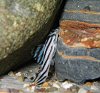 Hypancistrus
zebra Hypancistrus
zebra |
 Hypancistrus
zebra Hypancistrus
zebra Head view |
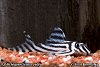 Hypancistrus
zebra Hypancistrus
zebra |
 Hypancistrus
zebra Hypancistrus
zebra |
 Hypancistrus
zebra Hypancistrus
zebra |
 Hypancistrus
zebra Hypancistrus
zebraJuvenile 4cm. |
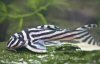 Hypancistrus
zebra Hypancistrus
zebra |
If you would like to contribute to the monthly factsheets with an article, information or photos, please e-mail me. You will of course be credited for your work.

If you would like to donate any denomination of monies to the site just click the above link button. All proceeds will go to running the site and hopefully to keep it going for a few years yet.

