SCOTCAT.COM
your internet guide to all things catfish
Sorubim elongatus Littmann, Burr, Schmidt & Isern, 2001 |
Image contributors to this species: |
Mark Henry Sabaj (1) IvanMikolji (2) |
ScotCat Sources: |


|
Other Sources: |
|


Relevant Information: |
Description: Dorsal soft rays (total): 6; Anal spines: 0; Anal soft rays: 20 - 25; Vertebrae: 44 - 46. Laterally positioned eyes, visible dorsally and ventrally; in adults, the diameter is 2.2-3.3 times into interorbital width. Inner mental barbels usually posterior to gular apex, rarely even with it, and never reaching fleshy margin of opercle. Outer mental barbels longer, extending beyond the origin of pectoral fins. Maxillary barbels variable in length, extending to pelvic fins or beyond. Pelvic fins when depressed reaching approximately halfway from anus to anal-fin origin. Habitat: Collected from both white and black waters; found in floodplain lakes, small creeks (or caños) to large rivers and tidal rivers; on sand, mud, and clay substrates associated with vegetation (e.g. tall reeds, emergent grasses, and root masses of stream-side trees). Apparently nocturnal and hide in groups along stream margins during the day. This species along with Sorubim lima are the two most seen species in this genus. There are another three that are that bit rarer, S. trigonocephalus, S. cuspicaudus and S. maniradii. Aquarium Care: Anything large enough will fit into its mouth so you should choose tankmates carefully. Large Cichlids or Plecos would be good companions or larger Characins, but they will also co-exist with one another, so 2 or 3 individuals brought together as juveniles in a larger tank (min. 6ft x 2ft x 2ft) would also be a good choice. Diet: In the aquarium it is important to try and wean them of live food so as not too make them too dependent on it and also not forgetting the disease factor as well. They will take a variety of larger foods such as earthworms, frozen bloodworms, tablet and pellet food. You can try prawns and also frozen fish pieces such as lancefish etc. Etymology: The specific name elongatus: Named for the elongated general shape of the body, particularly marked at the tip of snout, caudal peduncle, and caudal fin. |
Common Name: |
Slender shovelnose catfish |
Synonyms: |
None |
Family: |
Pimelodidae |
Distribution: |
South America: Essequibo, Orinoco, and Amazon basins. |
Size: |
30.0cm. (12ins) |
Temp: |
23-30°C (73-87°F) |
p.H. |
|
6.5-7.5. |
IUCN Red List |
Despite the little information available on this species, it has a wide range and no apparent threats. Therefore, it is assessed as Least Concern, (IUCN 2023). |
Reference: |
Littmann, M. W.
Systematic review of the neotropical shovelnose catfish
genus Sorubim Cuvier (Siluriformes: Pimelodidae) Zootaxa
1422: 1-29 (8 Mar. 2007) 14 plates; 42 references. |

Family: Pimelodidae Back to Ident-A-Cat Click on Thumbnails |
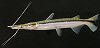 Sorubim elongatus
Semi-adult 17.6cm SL |
 Sorubim
elongatus Sorubim
elongatus |
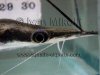 Sorubim
elongatus Sorubim
elongatusClose-up of eye |
If you would like to contribute to the monthly factsheets with an article, information or photos, please e-mail me. You will of course be credited for your work.

If you would like to donate any denomination of monies to the site just click the above link button. All proceeds will go to running the site and hopefully to keep it going for a few years yet.

