SCOTCAT.COM
your internet guide to all things catfish
Microglanis malabarbai Bertaco & Cardoso, 2005 |
Image contributors to this species: |
Enzo Edgardo Ferreyra (4) Felipe Alonso (1) |
ScotCat Sources: |
|

Other Sources: |
|


Relevant Information: |
Habitat: Microglanis malabarbai, is described from the Rio Ijuí drainage, tributary of the middle Rio Uruguay, Rio Grande do Sul, Brazil. The new species is distinguished from all other Microglanis species by the caudal fin colour pattern, almost completely black, with a narrow vertical white band across central portions of the caudal-fin rays. Furthermore, it is distinguished from M. cottoides and M. eurystoma, both from rio Uruguay drainage, by head length, maxillary barbel length, internareal distance, and number of lateral-line pores, and from M. cibelae from the coastal drainages of northern Rio Grande do Sul and southern Santa Catarina states, by head length, maxillary barbel length, and body width. All specimens of M. malabarbai were caught under dead tree branches and leaves in dark water, lentic stretches of shallow streams, with sand and mud on the bottom, and moderate amount of riparian vegetation. The Rio Ijuí drainage is surrounded mainly by soybean, wheat, and pasture plantations, with narrow areas of original vegetation on stream margins. Other species collected in same habitat with M. malabarbai are (all lots deposited at MCP): Cichlasoma dimerus, Crenicichla scotti, Heptapterus mustelinus, Hisonotus sp., Rhamdia quelen, and Rineloricaria sp. (Bertaco, V.A. and A.R. Cardoso, 2005). Aquarium Care: Microglanis malabarbai is one of twenty six, small to medium sized pims, found in this family, and as such is a good addition to the medium sized community tank, and will not harm the occupants unless they are small enough to fit into its mouth such as newly born fry and young fish. Diet: Can be fed a varied diet of tablet food, pellets, worm foods and frozen food such as bloodworm. Etymology: The specific name malabarbai: In honour of Luiz Roberto Malabarba for his active contribution to the knowledge of the Neotropical ichthyofauna. |
Common Name: |
None |
Synonyms: |
None |
Family: |
Pseudopimelodidae |
Distribution: |
South America: Uruguay River basin, Brazil and Uruguay. |
Size: |
5.0cm. (2ins) |
Temp: |
21-25°C (69-77°F) |
p.H. |
|
6.0-7.5. |
IUCN Red List |
Microglanis malabarbai is endemic to Brazil and occurs in the tributaries of the Ijuí River in Rio Grande do Sul, where the species is naturally infrequent and scarce. Its calculated extent of occurrence is approximately 260 km² and includes areas affected by dams, whose reservoirs promote the conversion of lotic environments into lentic ones, and agricultural activities, responsible for the deforestation of riparian vegetation and water pollution. Despite its restricted distribution and habitat quality loss, the species is not subject to a specific threat that characterises its population as severely fragmented, nor is it possible to estimate a reliable number of locations. For these reasons, Microglanis malabarbai was categorised as Near Threatened (NT), approaching Vulnerable (VU), as it meets criteria B1b(iii), (IUCN 2022). |
Reference: |
Bertaco, V.A. and A.R.
Cardoso, 2005. A new species of Microglanis
(Siluriformes: Pseudopimelodidae) from the rio Uruguay
drainage, Brazil. Neotrop. Ichthyol. 3(1):61-67. |

Family: Pseudopimelodidae Back to Ident-A-Cat Click on Thumbnails |
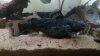 Microglanis malabarbai
Yapeyú Corrientes, Argentina |
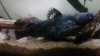 Microglanis
malabarbai Microglanis
malabarbaiYapeyú Corrientes, Argentina |
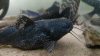 Microglanis
malabarbai Microglanis
malabarbaiHead view-Yapeyú Corrientes, Argentina |
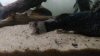 Microglanis
malabarbai Microglanis
malabarbaiCaudal view-Yapeyú Corrientes, Argentina |
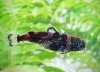 Microglanis
malabarbai Microglanis
malabarbaiJuvenile |
If you would like to contribute to the monthly factsheets with an article, information or photos, please e-mail me. You will of course be credited for your work.

If you would like to donate any denomination of monies to the site just click the above link button. All proceeds will go to running the site and hopefully to keep it going for a few years yet.

