SCOTCAT.COM
your internet guide to all things catfish
FACTSHEETS: January 2008 - no. 139
Akysis prashadi (Hora 1936) |
Akysis prashadi
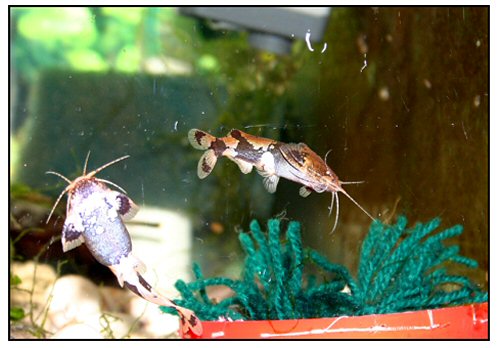
Sexing is relatively easy with the female having larger ventral and pectoral fins. There have been reports of their spawning, but as yet there are no reports of fry development.
Akysis prashadi - in aquarium.
Like other members of its genera, Akysis prashadi is more at home in aquaria having a sand substrate interspersed with small rocks and pebbles mixed with thick clumps of plants. Unless feeding, when they are highly active, they can be over looked in aquaria that has a sand substrate as they like nothing better than to bury themselves, leaving only their nasal barbels which protrude slightly from the sand to indicate where they are. So the next time you see a tank labelled ‘Akysis’ and there appears to be an empty tank, check the substrate to see if you see any barbels protruding out of the substrate. Water conditions although not critical, (as long as it is low in nitrates) should be provided with a temperature range of between 18°C and 27°C, and pH values of between 6.5 and 7.2. Feeding Akysis prashadi does not cause any difficulty, as long as you use frozen or live foods such as bloodworms, brine shrimps, white worms and daphnia, as they tend to ignore commercially prepared foods. |
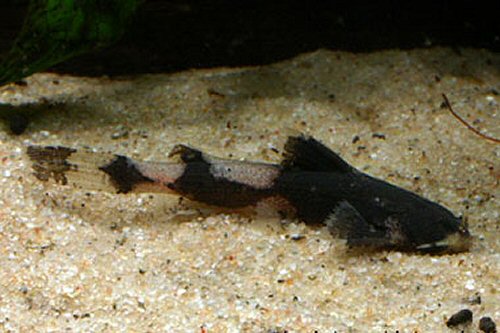
Akysis hendricksoni
|
| Akysis hendricksoni is often confused with Akysis prashadi and can be misidentified as such by our local fish stores, yet can be readily distinguished from Akysis prashadi by being somewhat smaller, having a narrower head and more closely set eyes.
|
 kysis
prashadi is one of
the largest of the species, one that we find frequently
in our local fish stores today, and one that is highly
active when feeding.
kysis
prashadi is one of
the largest of the species, one that we find frequently
in our local fish stores today, and one that is highly
active when feeding.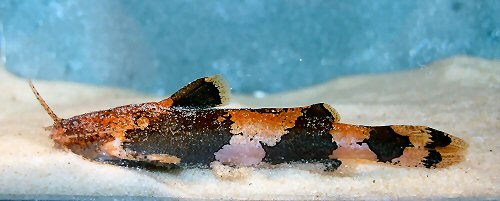
Common Name: |
Indawgyi stream catfish |
Synonyms: |
Akysis variegatus variegatus |
Family: |
Akysidae |
Subfamily: |
Akysinae |
Distribution: |
Asia: Irrawaddy river drainage, Myanmar. |
Size: |
6.5cm (2½ins) |
Temp: |
18-27°C (63-81°F) |
p.H. |
6.5-7.2. |
Characteristics |
Dorsal spines (total): 1 - 1; Dorsal soft rays (total): 4 - 5; Vertebrae: 34 – 35. Posterior edge of pectoral spine without serrations. Head length 20.6-23.8% SL; head width 21.4-25.1% SL; interorbital distance 35-37% HL; length of nasal barbel 63-68% HL. Caudal fin deeply emarginate. |
Colouration |
Head is a golden tan with brown speckles to it in colour, with the body also having a golden tan colouration to it, which contain three areas of dark brown along the body, the first running from the pectoral fin and ending level with the posterior edge of the dorsal fin, the second area starts midway between the ventral and anal fin and ending level with the posterior edge of the adipose fin, the third area runs through the caudal peduncle. There are thin brown irregular lines connecting these three bands, in some specimens these connecting lines can be absent or extremely thin, but generally it is usually the connecting line between the adipose and caudal brown areas that is hard to discern. |
Aquarium Care & Compatibility |
| Fish like barbs and rasbora’s make excellent tank mates, however as they have quite wide mouths, any fry from livebearers or fish around that size would be readily predated upon. |
Reproduction |
In their natural habitat they lay their eggs in nests constructed by the males in shallow, rocky areas in the summer months. There have been reported spawings in the home aquarium as well as in Public Aquaria. |
Sexual differences |
The females have larger ventral fins and deeper pectoral fins. |
Diet |
| Frozen or live foods such as bloodworms, brine shrimps, white worms and daphnia, as they tend to ignore commercially prepared foods. |
Glossary of Terms |
Dorsal:
The primary
rayed fin(s) on top of the body |
Etymology |
| Akysis:
A = without; kysis = bladder,
in reference to the lack of a swimbladder. |
IUCN Red List |
Although Akysis prashadi does not seem to have a wide geographic distribution, there are no known threats and occasional collection for the ornamental fish trade is not projected to adversely affect population, and it is assessed as Least Concern, but needs updating (IUCN 2010). |
References |
Froese,
R. and D. Pauly.
Editors. 2007. FishBase. World Wide Web electronic
publication. www.fishbase.org, version (10/2007). |
Photo Credits |
nos:
1 @ 2:
©
Adrian Taylor |
|

If you would like to contribute to the monthly factsheets with an
article, information or photos, please e-mail
me. You will of course be credited for your work.
If you would like to donate any denomination of money to the site just click the above link button. All proceeds will go to running the site and hopefully to keep it going for a few years yet.
ScotCat Sources
 Etymology-genera
Etymology-specific
name
Online Sources
 Search
 Fishbase
 Catalog of Fishes
 GBIF
GBIF
 Fishnet2
 iNaturalist
 IUCN
IUCN

