SCOTCAT.COM
your internet guide to all things catfish
FACTSHEETS: May 2000 - no. 047
Clarias batrachus (Linnaeus, 1758) |
Clarias
batrachus
- pair of Piebald/Pink There is a few varieties of Clarias batrachus, the normal coloured which is a slate grey to olive colouration with a white underbelly and an albino variation which unusual to most fish species, occurs in nature. The albino is of course white all over with red eye's. Another much prettier one is is the above image, piebald/pink, and has normal eye's. It received its common name of the 'Walking Catfish' on its ability to walk overland from pond to pond when their original habitat dries up or after a heavy rainfall. They possess a much reduced air-bladder and their gills are stiffened to prevent their collapse when out of water and in a special part of the gill chamber are spongy arborecent (tree-like) organs growing from the upper ends of the gill arches. These and the skin surrounding them, are well supplied with blood vessels and operate efficiently in water lacking in oxygen or when the fish is out of water. They of course keep their gills closed when out of water and as long as their body is kept moist they can stay on land for a considerable length of time.
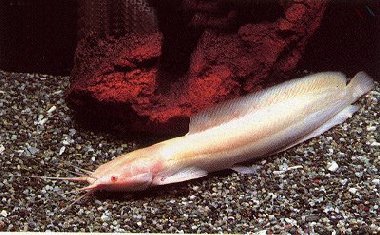
Clarias batrachus - albino
Their distinguishing features are of course its long dorsal fin ( 62-77 rays) without a spine and its long anal fin (45-63 rays). Both these fins usually have a break before the small rounded caudal fin but sometimes in odd specimens the fins of the dorsal and anal fuse to the caudal. Its pectoral spines are very strong (1 spine 8-11 rays) especially the leading spine which of course helps its odd lifestyle of moving about on dry land. It possess 4 pair of barbels, one pair of nasal, one pair of maxillary and two pairs of mandibular barbels.
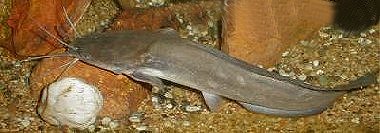
Clarias batrachus - normal variety
It is native to Southeastern Asia but was brought into the U.S. in the 1960's for fish farming and it was out of one of these farms in Florida in the mid 60's that the first escape occurred and the first catch of this fish was by an angler on the 15th March 1967. The first escapees originated from wild stock which was exported from Thailand. It is a threat to the native fish populations in the Florida and Gulf of Mexico areas and the only enemy of this fish (apart from the anglers) is if there is a very cold winter and they can not survive the long cold spell. As mentioned at the start of this factsheet, they are predators and very good escape artists as well so if you do fancy keeping them a tight lid is essential with large hiding places, a soft bottom ( sand or rounded gravel) and of course a large tank of 4ft or larger and outside filtration. The male of this species is usually more colourful than the female with a dark spot on the rear of the dorsal fin, the female does not possess this. This of course relates to the normal variety and I'm not sure if this could be applied to the albino, but the larger girth of the female in breeding condition would set them apart.
|
 his
is certainly one of these catfish that you should
keep "home alone" as it is a voracious predator
when it starts growing from the small cute catfish
that you bought from the local fish shop to the fast
growing predator that you see before your eyes!
his
is certainly one of these catfish that you should
keep "home alone" as it is a voracious predator
when it starts growing from the small cute catfish
that you bought from the local fish shop to the fast
growing predator that you see before your eyes!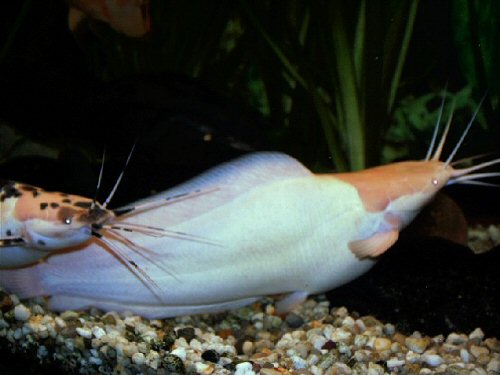
Common Name |
Walking Catfish |
Synonyms |
Silurus batrachus, Clarias magur, Clarias punctatus, Macropteronotus batrachus, Macropteronotus magur. |
Family |
Clariidae |
Subfamily |
- |
Distribution |
Asia: Java, Indonesia. Clarias aff. batrachus from Indochina and Clarias aff. batrachus from Sundaland have been misidentified as Clarias batrachus from Java. Introduced elsewhere. Several countries report adverse ecological impact after introduction. |
Size |
60.0cm (24ins) Should grow to about 18ins in the Aquarium. |
Temp |
20-25°c (67-77°f.) |
p.H. |
6.0-7.5. |
Characteristics |
Dorsal fin 62-77 rays without a spine. Anal fin 45-63 rays. Both these fins usually have a break before the small rounded caudal fin but sometimes in odd specimens the fins of the dorsal and anal fuse to the caudal. Pectoral;1 spine 8-11 rays. 4 pair of barbels, one pair of nasal, one pair of maxillary and two pairs of mandibular barbels. |
Colouration |
There is a few varieties of Clarias batrachus, the normal coloured which is a slate grey to olive colouration with a white underbelly. Albino, white all over with red eye's. Another variety is piebald/pink and has normal eye's. |
Aquarium Care & Compatibility |
| Very much a predator so would need to be kept alone or with its own kind as in a pair. |
Reproduction |
It is reported that they engage in mass spawning migrations in late spring and early summer. Adhesive eggs are laid in a nest or in submerged vegetation and the males guard the eggs. There is a breeding report published in the German magazine DATZ (7/04, pages 12-15) by Wolfgang Ros. Below is a short extract in English kindly supplied by Wolfgang from his article: "At least in the breeding time of Clarias batrachus there seems to be a kind of pair connection. The mating altogether takes about 20 hours. Before both partners are digging a hollow, which has a diameter of approximately 12 inch. In some descriptions also the building of a nest is described. I cannot confirm that. There are some hundreds up to a thousand eggs. As soon as the female delivered all eggs, it avoids the mating hollow. This part is guarded only by the male, the female secures the place behind. The embryos slipped out after approximately 30-40 hours. After further two days both partners are no more protecting the spawn." You can access further articles on ScotCat of Clarias batrachus by Wolfgang below. Final
speech for the “Walking Catfish”, Clarias
batrachus |
Diet |
| In its native habitat it is a scavenger and will eat smaller fish and are opportunist feeders and so will eat just about anything!. In the aquarium they are not fussy feeders but fish of some sort should be on the menu but does not necessary need to be live food. |
Etymology |
| Clarias:
Clear
or shining. |
IUCN Red List |
This is a widespread species with no known major widespread threats. Therefore, it is assessed as Least Concern. (IUCN 2019). |
References |
Baensch;
Aquarium Atlas1.1989. |
Photo Credits |
Top: ©
Wolfgang Ros |

|

If you would like to contribute to the monthly factsheets with an
article, information or photos, please e-mail
me. You will of course be credited for your work.
If you would like to donate any denomination of money to the site just click the above link button. All proceeds will go to running the site and hopefully to keep it going for a few years yet.
ScotCat Sources
 Article
Article
Article
 Art Gallery
 Etymology-genera
Etymology-specific name
Online Sources
 Search
 Fishbase
 Wikipedia
 Catalog of Fishes
 GBIF
GBIF
 Fishnet2
 iNaturalist
 IUCN
IUCN

