SCOTCAT.COM
your internet guide to all things catfish
FACTSHEETS: July 2009 - no. 157
Gastrodermus pygmaeus Knaack, 1966 |
|
Gastrodermus pygmaeus
This small Corydoras/Gastrodermus has a lot going for it as it is easy to keep and breed and has been popular with Cory enthusiasts even although there has been an influx of C-numbers to even challenge the many L-numbers of the huge, in numbers, Loricariidae family. This Cory has even done well on the show bench at fish shows up and down the country as it is small, and if in good condition can be hard to beat.
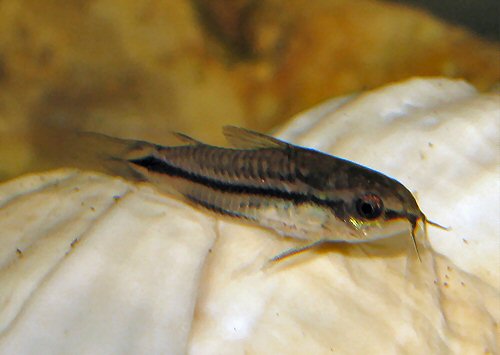
Gastrodermus pygmaeus - showing good healthy barbels
Remarks: Corydoras pygmaeus is placed in Lineage 4 which includes two of the dwarf species and a revison would be a resurrection of the disused Microcorydoras (Myers, 1953) with the designated type species: C. hastatus. As of the latest update Corydoras pygmaeus has now been placed in Lineage 5 and has the new genus name of Gastrodermus (2024).
|
 e concentrate this month on the last of the three
so called "Dwarf Cory" factsheets. We have
compiled already on
e concentrate this month on the last of the three
so called "Dwarf Cory" factsheets. We have
compiled already on 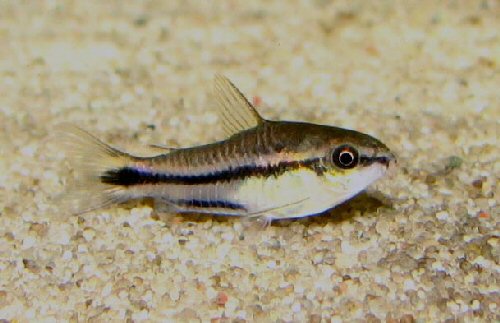
Common Name |
Pygmy Cory |
Synonyms |
Corydoras pygmaeus |
Family |
Callichthyidae |
Subfamily |
Corydoradinae |
Distribution: |
South America: Brazil, Tributaries of the Rio Madeira, near Calama. Ecuador, Tributaries of the Rio Aguarico. Peru, Rio Nanay, west of the city of Iquitos. Type locality: einem Nebenfluß des Rio Madeira (Brasilien). |
Size |
Male: 2.5cm (1ins) Female: 3.0cm (1¼ins) |
Temp. |
22-26°C (71-79°F) |
p.H. |
6.0-7.2. |
Characteristics |
Head, short and compact. |
Colouration |
Ground colour of head and body grey/green. A blackish line runs from the tip of the snout through the junction of the body scutes and ends at the caudal peduncle, where it broadens out into a triangular shape. Dorsal parts of dorsolateral body scutes with darker pigment on the posterior edges. Ventrolateral body scutes creamy white except for a dark line which runs from the ventral fins to the anal fin. |
Aquarium Care & Compatibility |
| Best kept in a species only tank but can be housed in a small community tank if co-inhabitants are picked carefully; such as small tetras and dwarf rasboras. |
Reproduction |
Relatively simple, will breed in typical Corydoras T-mating fashion with usually one single egg laid on plants or the aquarium glass, they can lay up to 100 eggs this way. The parents very rarely predate on the eggs. The resulting fry are quick growing on a diet of microworm and crushed flake. You can access the breeding section on Corydoras/Gasstrodermus spawning methods here. |
Sexual Differences |
Females are noticably heavier when in breeding condition. They also grow larger than the smaller males. |
Diet |
| Small foods such as microworm, grindal worm, good quality flake and tablets. Frozen foods such as bloodworm. |
Glossary of Terms |
Anal Fin:
The fin forward from the anal cavity. |
Etymology |
| Gastrodermus:
The
lining membrane of the alimentary tract of an invertebrate,
used especially when the germ-layer origin is obscure. |
References |
Alexandrou,
Markos & Taylor, Martin. (2011). Evolution,
ecology and taxonomy of the Corydoradinae revisited. |
Photo Credits |
| Top: © Graham
Ramsay |
|

If you would like to contribute to the monthly factsheets with an article, information or photos, please e-mail me. You will of course be credited for your work.
If you would like to donate any denomination of money to the site just click the above link button. All proceeds will go to running the site and hopefully to keep it going for a few years yet.
ScotCat Sources
 Etymology-genera
Etymology-specific name
Online Sources
 Search
 Fishbase
 Wikipedia
 Catalog of Fishes
 GBIF
GBIF
 Fishnet2
 iNaturalist

