SCOTCAT.COM
your internet guide to all things catfish
FACTSHEETS: October 2002 - no. 076
Farlowella acus (Kner, 1853) |
Farlowella acus
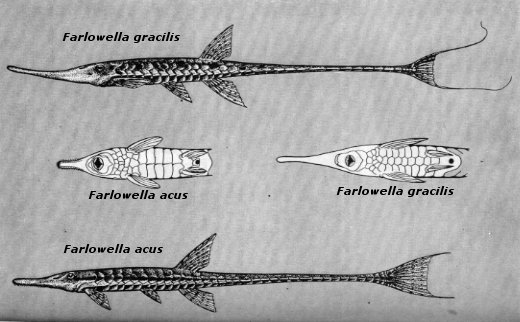
The genus name of Farlowella is named in honour of William Gibson Farlow the famous American botanist of the last century, and the beginning of the 21st, who's main work was actually working with algae plants which brings us to the one of the most favourite foods of this slender catfish "algae". It is quite difficult to get a right balance in feeding this species as greens are predominately its main food and they do not do all that great on meaty foods such as bloodworm, frozen or live, or any other types of worm food, algae wafers are another good possibility. Water quality is another issue as Farowella do not take kindly either to large wholesale water changes as they quickly succumb to the shock of such an action. A better idea is to make two or three small water changes per week with aged water so as not to upset their equilibrium. There are at present (2002) 36 species of Farlowella with F. acus, F. vittata and F. gracillis being the most commonly exported varieties. There is large and slight differences between the different types which sometimes can lead to confusion in the hobby not to mention the headaches that the Judges on the show circuits have to put up with (so I won't mention it :-)) One very important I.D. is the ventral scutes on these species and it is one way of differentiating between them. Below are two line drawings of such a scenario.
Also in the line drawing above you can see the differences between the elongated snouts of the two species with F.gracilis being the longer and slimmer with F.acus with the shorter snout, and also the threadlike appendages adorning the caudal fin of F.gracilis. The identify of members of this genus is carried out by looking at the ventral plates (underneath the mouth to anal area) to identify to species. F.acus (F.acus species group) has two rows of abdominal scutes, no median scute at the base of the pelvic fins (occasionally found in species of the Farlowella curtirostra species group), and fairly long breeding odontodes on the snout (found on no other species of Farlowella). To sex out this species is comparatively easy as the male (in breeding condition anyway) has a broader snout (rostrum) from the female and is adorned with short bristles. Sometimes it is hard in young specimens to tell this difference but I have always found a sure fire method by running your fingers along the snout of a captured specimen and you can feel the slight roughness of the male compared to the female.
Farlowella acus is a native of Venezuela and some records show catchment areas of Colombia and Brazil but they may have been specimens of other species of Farowella such as F. gracilis or F. gladiola.
|
 he
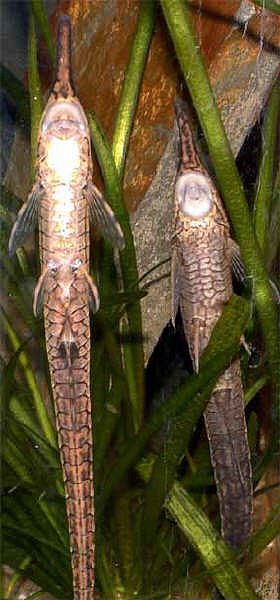
common name of "Twig Catfish" certainly
sums up this member of the Loricariidae family as
one look at the picture shows an animal reassembling
a twig or stick and it is now sadly a forgotten "pleco"
with the onslaught of the L-numbers in the last 10
years or so relegating this once sought after catfish
to the memories of yesteryear.
he
common name of "Twig Catfish" certainly
sums up this member of the Loricariidae family as
one look at the picture shows an animal reassembling
a twig or stick and it is now sadly a forgotten "pleco"
with the onslaught of the L-numbers in the last 10
years or so relegating this once sought after catfish
to the memories of yesteryear.
Common Name |
Twig Catfish |
Synonyms |
Acestra acus |
Family |
Loricariidae |
Subfamily |
Loricariinae |
Distribution |
South America: Venezuela, Lake Valencia and Torito River. |
Size |
18.0cm. (7ins) |
Temperature |
24-26ºC (75-79°f) |
p.H. |
6.0-7.0. |
Characteristics |
D1/6; A1-5; P1/5-6; V1/4-5; 33-34 bony scutes in a lateral series. On the belly the rows of of lateral scutes are closely aproximated. Snout 4-4½ times in the distance from its tip to the anus (snout tip to front of mouth). |
Colouration |
Olive-green to yellow-brown, underside yellowish. A very distict irregular dark band, often beset with blotches, extends from the head to the root of the tail. Fins transparent, the rays with dark spots. Each caudal lobe with a dark band. |
Aquarium Care & Compatibility |
| An easy catfish to keep? no I don't think so as there have been many unexplained deaths attributed to this species (myself included) and as such would need dedicated care from an experienced catfish keeper who has worked with this species or its close cousin from the easier kept Sturisoma genera. As this is a very timid species, if housed with other inhabitants you would be better keeping away from boisterous fish such as some of the Barb species (such as tigers) and definately Cichlids. Better companions would be the unobstrusive Corydoras species and small Characins or Rasboras. |
Reproduction |
In the aquarium the male will clean a hard surface usually the aquarium wall and the female lays its eggs last thing at night or early morning with upwards of 60-80 laid. The male mouths and fans the eggs with his pectoral fins and they hatch in 6-10 days depending on the temperature, thereafter the problems start as you will have to feed them more or less right away on the right foods. This is where a well matured and planted aquarium would be beneficial as the fry can feed of the established plant material and the micro bacteria in the tank and also be supplemented with lettuce, corgette (zucchini) and cucumber but it will not be an easy task as high losses are reported in the first few weeks of life until they can get a foothold on life. A good method of feeding which has had a good success rate, is green peas squeezed out of the shell and crushed into a paste which you can then sprinkle at the front of the tank so you can see at the end of the day what has been left over, and then subsequently siphon the waste out and replace again. This should be done every day. In their natural habitat they spawn from between November and March but can be induced at any time (if in good condition) in captivity. |
Diet |
| They are mostly vegetarian with algae being their number one source of food for adults and young fry so the above mentioned foods along with vegetable laden tablets should suffice. |
Etymology |
| Farlowella:
Named in honour of W.G.Farlow of Harvard University.
|
IUCN Red List |
Farlowella acus is classified as Vulnerable. The distribution of F. acus is restricted to streams in upper plains and piedmonts in two separate areas: tributaries to Valencia Lake and upper Meta and Guaviare systems, both drainages with different conservation statuses but with bad prognosis for the species. Human intervention is increasing in the Meta and Guaviare drainages, but there are still conserved tributaries and protected areas that can satisfy protection measures for the species. The most critical situation is in the Lake Valencia drainage, where the expansion of the agro-industries and cities affects all tributaries and there are no mitigation measures. The area of occupancy (AOO) is best estimated at 1,308 km2 and there are 2-4 threat-based locations based on these threats, which are causing a continuing decline in the habitat. There are no protected areas for the habitat for the Farlowella acus. Urgent measures are recommended for the protection of the species, which should include general assessment of the habitat and population, as well as the restoration of the habitat (IUCN 2021). |
References |
Catfish
Association of Great Britain; Vol.1. |
Photo Credits |
| Top
& Bottom Pictures: © Sam Storry |
|

If you would like to contribute to the monthly factsheets with an article, information or photos, please e-mail me. You will of course be credited for your work.
If you would like to donate any denomination of money to the site just click the above link button. All proceeds will go to running the site and hopefully to keep it going for a few years yet.
ScotCat Sources
 Etymology-genera
Etymology-specific name
Other Sources
 Search
 Fishbase
 Wikipedia
 Catalog
of Fishes
Catalog
of Fishes
 GBIF
GBIF
 Fishnet2
 iNaturalist
 IUCN
IUCN

