SCOTCAT.COM
your internet guide to all things catfish
FACTSHEETS: June 2004 - no. 096
Gastrodermus guapore (Knaack, 1961) |
Gastrodermus
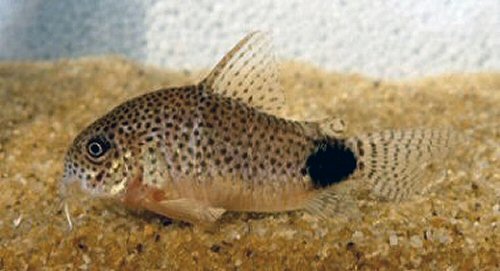
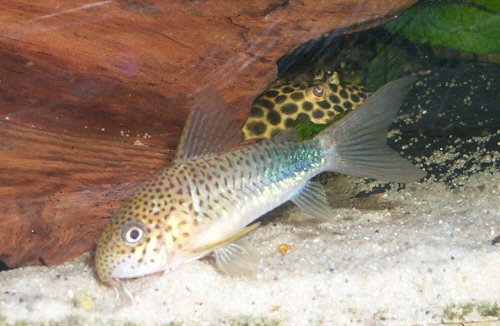
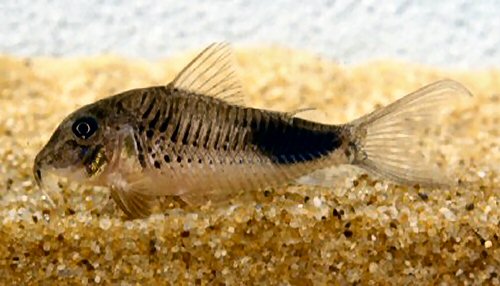
guapore It is as with many Corydoras/Gastrodermus, inoffensive in the aquarium and will tend to shoal in the middle layers of the tank much like Gastrodermus pygmaes and G. hastatus so it would be better with its own kind in a group to make it feel more secure in its surroundings. There are three species that are similar to G. guapore, being Hoplisoma caudimaculatum, Corydoras ourastigma and Hoplisoma simile. H. caudimaculatum from lineage 9 is a more stockier looking fish with many spots on the body, Corydoras ourastigma from lineage 1 has an elongated snout and a larger blotch on the caudal peduncle and H. similis from lineage 9 has a metalic blue/green body colouration and has a fainter blotch to its caudal peduncle. As you can see in the top picture that G. guapore has also a distinct body shape and large eye. Also similar in colour patterns to Hoplisoma cruziense and Gastrodermus mamore.
Hoplisoma caudimaculatum- lineage 9
Hoplisoma simile- lineage 9
Corydoras ourastigma - lineage 1
Will do best in a group of about 6 in a planted tank with hiding places and a soft substrate such as sand or a smooth gravel base. Filtration is a personal choice with either internal or external power filters with a good water flow. It is not the easiest Gastrodermus to find in the aquatic shops and not the cheapest either, but if you can afford it and have the tank space, it is one of the nicest looking cory's around, and you could maybe be one of the few to spawn this species. |
 his
pretty little Cory was first collected by Harald Schultz
in the Rondõnia area of Brazil in the main
streams of the upper Rio Guapore and was thus named
after this river by Jocham Knaack in 1961.
his
pretty little Cory was first collected by Harald Schultz
in the Rondõnia area of Brazil in the main
streams of the upper Rio Guapore and was thus named
after this river by Jocham Knaack in 1961.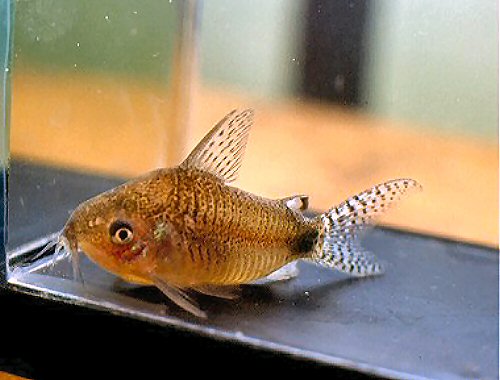
Remarks: Corydoras guapore is placed in Lineage 4 which includes two of the dwarf species and a revison would be a resurrection of the disused Microcorydoras (Myers, 1953) with the designated type species: C. hastatus. As of the latest update Corydoras guapore is now been placed in Lineage 5 and has the new genus name of Gastrodermus (2024).
|
Common Name |
Guapore Cory |
Synonyms |
Corydoras guapore |
Family |
Callichthyidae |
Subfamily |
Corydoradinae |
Distribution |
South America: Brazil, Guaporé River basin. Type locality: Brasilien, im Hauptstrom des oberen Rio Guaporé. |
Size |
5.0cm (2ins) |
Temp |
23-27°C (73-81°F) |
p.H. |
6.0-7.2. |
Characteristics |
Head short and compact. Large eyes. Shaped more in common with the dwarf Cory's such as G. pygmaes and G. hastatus. |
Colouration |
Sandy coloured body, can turn to a orange/yellow when in good condition with very fine spots. Blackish/blue blotch to caudal peduncle. Adipose fin with black blotch to rear. Dorsal fin with spotted bands. Caudal fin with noticeable banding, of 8 to 10 rows of spots. |
Aquarium Care & Compatibility |
| This is akin to most of this genus, very peaceful, and would be best housed with small to medium tankmates such as Tetras Rasboras and Danios. |
Reproduction |
Not been bred as often as some other Corydoras/Gastrodermus but keeping up the water changes regularly will hopefully entice them to show an interest in breeding. There is an article where there has been success with this species on ScotCat. |
Diet |
| Can be fed most aquarium fare such as good quality flake, grindel and white worm, tablet foods and frozen foods such as bloodworm. Also keen on Brine Shrimp Naupli. |
Etymology |
| Gastrodermus:
The
lining membrane of the alimentary tract of an invertebrate,
used especially when the germ-layer origin is obscure. |
References |
Alexandrou,
Markos & Taylor, Martin (2011). Evolution,
ecology and taxonomy of the Corydoradinae revisited. |
Photo Credits |
© Allan James
@ |


|

If you would like to contribute to the monthly factsheets with an
article, information or photos, please e-mail
me. You will of course be credited for your work.
If you would like to donate any denomination of money to the site just click the above link button. All proceeds will go to running the site and hopefully to keep it going for a few years yet.
ScotCat Sources
 Article
 Etymology-genera
Etymology-specific name
Online Sources
 Search
 Fishbase
 Wikipedia
 Catalog of Fishes
 GBIF
GBIF
 iNaturalist

