SCOTCAT.COM
your internet guide to all things catfish
FACTSHEETS: June 1999 - no. 036
Pseudoplatystoma fasciatum (Linnaeus, 1766) |
Pseudoplatystoma fasciatum
Similar to Pseudoplatystoma tigrinum but P.tigrinum has more of a striped pattern. The specimen pictured above was taken at The Port Doree Public Aquarium in Paris, France. There has been a small influx to the hobby of a crossed version of this fish and a close relation Pseudoplatystoma tigrinum with the Red Tailed Catfish (Phractocephalus hemioliopterus) which were primarily hormone bred for the food market in South America but some found there way into the aquatic hobby. There are also hybrids between the Red Tailed Catfish and the Tiger Fish, Brachyplatystoma tigrinum, and a few other large Pimelodid crosses along the way. My view is that these large fish have an imposing beauty all of their own without us having to inbreed them into any mongrel varieties.
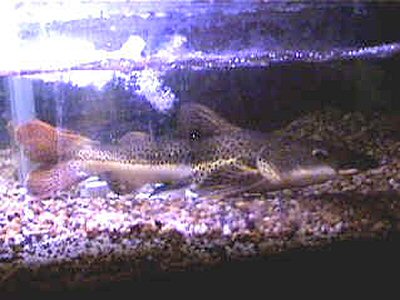
The picture above depicts a crossed variety which may be Phractocephalus hemioliopterus x Pseudoplatystoma tigrinum or Pseudoplatystoma fasciatum x Phractocephalus hemioliopterus or Phractocephalus hemioliopterus x Merodontotus tigrinus. In saying all this there has been aquarists who have successfully kept Pseudoplatystoma fasciatum and its close cousin Pseudoplatystoma tigrinum over the years but weighed against this is the number of "Tiger Shovelnoses" that have succumbed in aquarists tanks due to inexperience and neglect. So please only keep this fish if you can give it 100% commitment and give it the bigest tank that you can deliver bearing in mind that you will have to make it a large footprint i.e. plenty of inches from front to back of tank. I have to confess that I have tasted this species on the plate on my fish collecting trip to Peru in July 2000. The local name for this fish in Iquitos is "Dorada" and it is delicious.
Remarks: There has now been 5 new species described by Buitrago-Suárez, U.A. and B.M. Burr in 2007, to go alongside P. tigrinum, P. fasciatum and P. corruscans. These species are P. punctifer (Castelnau), P. reticulatum Eigenmann & Eigenmann, P. orinocoensen, P. metaense, and P. magdaleniatum. So far P. punctifer is the only species that has not been accepted in some publications in print and on the internet. Two species (P. punctifer ? and P. tigrinum) are sympatric in the Amazon Basin, two (P. metaense and P. orinocoense) are sympatric in the Orinoco Basin, and two others, P. corruscans and P. reticulatum, are sympatric in the Paraná. Pseudoplatystoma magdaleniatum and P. fasciatum each occur as the only species of Pseudoplatystoma in their respective individual ranges.
|
 he
"Tiger Shovelnose" is an out-and-out predator,
so it should not be kept with any fish that is smaller
than itself and it also should be housed in a very
large tank. The best companions would probably be
large Pacu's or similar sized fish that would not
be swallowed.
he
"Tiger Shovelnose" is an out-and-out predator,
so it should not be kept with any fish that is smaller
than itself and it also should be housed in a very
large tank. The best companions would probably be
large Pacu's or similar sized fish that would not
be swallowed.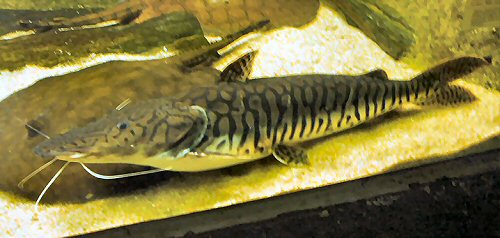
Common Name |
Tiger shovelnose catfish |
Synonyms |
Platystoma fasciatum, Platystoma punctifer, Platystoma truncatum, Pseudoplatystoma punctifer, Silurus fasciatus |
Family |
Pimelodidae |
Subfamily |
Surubiminae |
Distribution |
South America: Amazon, Corintijns, Essequibo, Orinoco and Paraná River basins. |
Size |
90.0cm (36ins) |
Temp. |
24-28°C (75-83°F) |
p.H. |
6.5-8.0. |
Hardness |
4-30° dGH |
Characteristics |
Body elongate and streamlined, head long and depressed. Upper jaw longer than lower jaw. One pair of long maxillary barbels and two pairs of shorter mandibular barbels. Caudal fin deeply forked. |
Colouration |
Body silvery grey along the sides, shading to olive along the back. Underside creamy white. Markings variable, usually vertical dark stripes and blotches. Fins usually spotted. |
Aquarium Care & Compatibility |
| Its tank should have a shaded area at the back such as a large branch and plants to hide under as it is nocturnal, and also the lighting should not be too bright. Should not be kept with any fish that is smaller than itself and it also should be housed in a very large tank. The best companions would probably be large Pacu's or similar sized fish that would not be swallowed. In my opinion this wonderful looking Pim should only be kept in Public Aquariums as it can damage its large nose if kept in too confined an area, it can get jumpy too if feels its barbels on the tank sides as it turns around. It can also go of its food as well, if it is anyway disturbed. |
Reproduction |
Not known. |
Sexual Differences |
Females tend to be fuller and heavier than the males. |
Diet |
| In their natural habitat they eat other fish such as characins and other catfish, they also eat freshwater crabs. In the aquarium a diet of earthworms, freshwater fish such as trout and also shrimp and prawns. You should only feed when it starts looking actively for it, as they will rest for a few days after feeding to digest their food. |
Etymology |
| Pseudoplatystoma:
Pseudos = fallacy; platys = broad; stoma
= mouth. |
Glossary of Terms |
Hybrid:
The progeny of two individuals belonging to different
species; the progeny of two individuals belonging to
different subspecies of the same species are not hybrids. |
References |
Buitrago-Suárez,
U.A. and B.M. Burr, 2007. Taxonomy of the catfish
genus Pseudoplatystoma Bleeker (Siluriformes: Pimelodidae)
with recognition of eight species. Zootaxa 1512:1-38.
|
Photo Credits |
Top image: © Allan
James @ |

|

If you would like to contribute to the monthly factsheets with an article, information or photos, please e-mail me. You will of course be credited for your work.
If you would like to donate any denomination of money to the site just click the above link button. All proceeds will go to running the site and hopefully to keep it going for a few years yet.
ScotCat Sources
 Art
Art
 Etymology-genera
Etymology-specific name
Online Sources
 Search
 Fishbase
 Catalog of Fishes
 GBIF
GBIF
 Fishnet2
 iNaturalist

