SCOTCAT.COM
your internet guide to all things catfish
FACTSHEETS: October 1997 - no. 016
Synodontis eupterus Boulenger, 1901 |
Synodontis eupterus
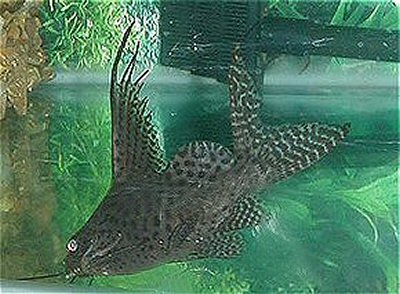
When young, these fish are sold here in the U.K. as Synodontis 'network' and are quite common. They have a striped pattern when youngsters but gradually lose this trait, and this disappears to be replaced by spots over the top half of the body. The first thing you do notice as adults is of course the magnificent dorsal fin with each ray extending into long filaments which can vary in different individuals, hence the common name of 'feather fin' catfish. You can see this trait in the second photograph. The only aggression that I have witnessed with this species is when I introduced a Synodontis membranaceus to his 6' 0" tank ( its a male) and all hell broke loose. I then moved him to another tank which included a Synodontis greshofi and they get on just fine. I think with most Synodontis you have to watch them, and who you put in to their quarters with them, as some can be more aggressive than others. These fish can be territorial, so give them caves to make them feel
Synodontis eupterus
Synodontis eupterus is one of these Syno's which can become quite tame and can appear to the front of the tank at all times of the day looking for food and just showing to the rest of the tank inhabitants that he/she is boss. The colouration is not startling but never the less it is an impressive fish which I think, being a bit bias, the vast majority of the Synodontis genus are anyway. I have a good friend who has been keeping around 14 of these fish together in a 4' x 2' x 2' tank for the last 5 years and trying to breed them. He has had eggs of them only once, but they didn't amount to anything. He finds them quite aggressive, especially a big female who has killed fish that he has introduced to the tank. I think this is the exception to the rule as his fish are in a so called breeding colony, and would view introduced fish as a threat to their territories. The genus Synodontis sports three pairs of barbels 1pair: maxillary, 1 pair: outer mandibular and one pair of inner mandibular barbels that are branched (filaments). There are only three species that have filaments on their maxillary barbels as well as the mandibular, and they are, S. clarias, S. decorus and S. flavitaeniatiatus.
|
 his
is one of my favourite Syno's and I have had this
specimen in the following photograph for about 10
years, from a striped juvenile in 1992 to around the
7" SL. mark now.
his
is one of my favourite Syno's and I have had this
specimen in the following photograph for about 10
years, from a striped juvenile in 1992 to around the
7" SL. mark now.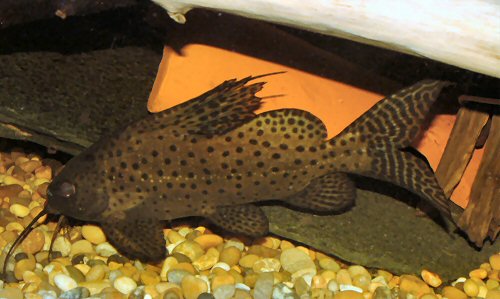
Common Name |
Feather-Fin Catfish |
Synonyms |
Synodontis macrepipterus |
Family |
Mochokidae |
Subfamily |
Mochocinae |
Distribution |
Africa: White Nile, Chad, Volta and Niger basins including the Bénoué. |
Size |
16.5cm (6½ins) |
Temp. |
22-26°C (71-78°F) |
p.H. |
6.2-7.5. |
Characteristics |
Dorsal 1/8; Pectoral 1/9; Mandibular teeth;40-56. Mandibular barbels reaching the base of the pectoral fin. Large sail-like dorsal. |
Colouration |
Darkish brown/grey body and dotted all over with small black spots, ventral parts lighter. Head and upper half of body and adipose fin spotted (spots vary from fish to fish). Remaining fins are liberally covered with black spots. In young specimens the caudal fin is striped and, as the fish matures, the stripes seperate forming spots. |
Aquarium Care & Compatibility |
| Can sometimes be quarrelsome depending on the individual fish so would be better in a larger tank with other fish such as larger barbs and tetras such as the "Congo Tetra". Will try and establish itself as the boss of the tank, then once the hierarchy is sorted out things should settle down. Make sure there are plenty of hiding places for this fish so it does not feel under threat from the other tankmates. |
Reproduction |
Not reported but would be a prime candidate for hormone production, if that is not being done already. Sexing can be quite easy in well fed individuals as the females can get quite heavy while the males stay comparatively slim. You can sex them of course by the genital papilla which drops down in the male to a point while the females are blunt. |
Diet |
| The adults will eat a wide variety of foods and that is the key to keeping Syno's fit and healthy, a wide varied diet. They will take flake, tablet food, prawns, shrimps and frozen bloodworm. |
Etymology |
| Synodontis:
Syn = together; odontis = teeth
(fused tooth plates). |
IUCN Red List |
This species has a wide distribution, with no known major widespread threats. It is therefore listed as Least Concern (IUCN 2020). |
References |
Awaïss,
A., Getahun, A., Lalèyè, P. & Olaosebikan,
B.D. 2020. Synodontis eupterus. The
IUCN Red List of Threatened Species 2020. |
Photo Credits |
Top
Image: © Allan James @
|

|

If you would like to contribute to the monthly factsheets with an article, information or photos, please e-mail me. You will of course be credited for your work.
If you would like to donate any denomination of money to the site just click the above link button. All proceeds will go to running the site and hopefully to keep it going for a few years yet.
ScotCat Sources
 Article
 Art Gallery
 Etymology-genera
Etymology-specific name
Other Sources
 Search
 Fishbase
 Wikipedia
 Catalog
of Fishes
Catalog
of Fishes
 GBIF
GBIF
 Fishnet2
 iNaturalist
 IUCN
IUCN

