SCOTCAT.COM
your internet guide to all things catfish
FACTSHEETS: March 1999 - no. 033
Synodontis robbianus Smith, 1873 |
|
Synodontis robbianus
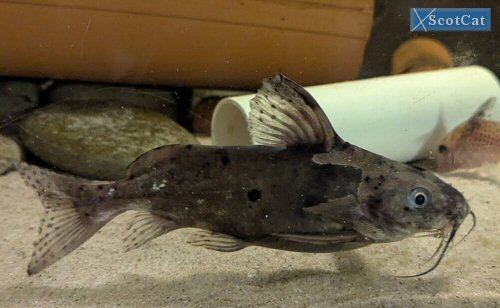
Synodontis nigrita has a slightly different body shape being more square shaped than S. robbianus and also grows larger at 17.5cm. Both species are spotted over most of the body although there are specimens that have very few spots. The fins also carry spots. To confuse matters more S. robbianus is also similar to S. obesus but the latter has a smaller adipose fin and shorter maxillary barbels than the former. In young fish the dorsal and caudal fins are striped, the stripes break up to form spots as the fish matures. Is this a community Synodontis?. Indeed it is and can be kept with most species. It does not seem to be too territorial and is very hardy as I have proved when I found my newly acquired specimen, bought a good many years ago, on the floor of my fishhouse when I opened up one morning. I don't know how long it had been lying there but when I popped it back into its tank again it contracted over the next few days, velvet disease. I treated it as per instructions and I still have it 10 years later. The genus Synodontis sports three pairs of barbels 1pair: maxillary, 1 pair: outer mandibular and one pair of inner mandibular barbels that are branched (filaments). There are only three species that have filaments on their maxillary barbels as well as the mandibular, and they are, S. clarias, S. decorus and S. flavitaeniatiatus.
|
 his
Synodontis species can be easily mixed up with
his
Synodontis species can be easily mixed up with
Common Name |
Brown-spotted Syno |
Synonyms |
None |
Family |
Mochokidae |
Subfamily |
Mochocinae |
Distribution |
Africa: Lower Niger and Cross River (Old Calabar) in Nigeria. |
Size |
13.0cm (5ins) |
Temp. |
22-25°C (71-77°F) |
p.H. |
6.2-7.5. |
Characteristics |
Skin of flanks non villeuses. Humeral process pointed. Mouth twice as wide than long, premaxillary teeth in a strip. Eye relatively large and the snout short. |
Colouration |
Ground colour of head and body, brown, lighter towards belly region. Dark spots on the body mostly confined to the upper parts, (the amount can vary). Pectoral, ventral and anal fins dark brown. Dorsal and caudal fins spotted, adipose fin the same colour as the body. |
Aquarium Care & Compatibility |
| Good community catfish in a larger setup but as with all Syno's will need their own space, meaning their own bit of bogwood, PVC pipe or rockwork to reduce the territorial behaviour of this genus. |
Reproduction |
Not recorded. |
Sexual Differences |
Not known, but the females are deeper bodied than the males. |
Diet |
| Will take most prepared aquarium foods such as frozen bloodworm, whiteworm, shrimp, prawns, tablet food, flake food and pellets. A wide varied diet will provide a healthy specimen for many years. |
Etymology |
| Synodontis:
From the Greek syn, meaning together, and odontos,
meaning tooth; in reference to the closely-spaced
lower jaw teeth. |
IUCN Red List |
Synodontis robbianus is only known certainly from the type locality at Ikot Okpora in the Cross river system, Nigeria. A second occurrence in the Bamingui River in Central Africa Republic needs further confirmation. Without further information on its distribution or threats, a full assessment cannot be made. It is assessed as Data Deficient (DD), (IUCN 2020). |
References |
Ferraris,
C.J. Jr., 2007. Checklist of catfishes, recent
and fossil (Osteichthyes: Siluriformes), and catalogue
of siluriform primary types. Zootaxa 1418:1-628. |
Photo Credits |
© Allan
James @
|

|

If you would like to contribute to the monthly factsheets with an article, information or photos, please e-mail me. You will of course be credited for your work.
If you would like to donate any denomination of money to the site just click the above link button. All proceeds will go to running the site and hopefully to keep it going for a few years yet.
ScotCat Sources
 Etymology-genera
Etymology-specific name
Other Sources
 Search
 Fishbase
 Wikipedia
 Catalog
of Fishes
Catalog
of Fishes
 GBIF
GBIF
 Fishnet2
 iNaturalist
 IUCN
IUCN

