SCOTCAT.COM
your internet guide to all things catfish
FACTSHEETS: December 2002 - no. 078
Bagarius bagarius (Hamilton, 1822) |
Bagarius
bagarius Bagarius bagarius is commonly known as the Devil Catfish, which is also referred to as Bagarius yarellii (now a synonym of Bagarius bagarius). This catfish is quite a rare find amongst shipments of fish from Asia. Bagarius bagarius belongs to the family Sisoridae which are more commonly referred to as Asian Hillstream Catfishes. Within this group of catfish there are around 23 genera and 85 species. As their family name suggests they are naturally found in the fast flowing freshwaters of southern Asia. Most of the catfish within the family Sisoridae are small to medium in size from 6-30cm, with the exception of Bagarius with representative species growing in excess of 2 metres! Bagarius are described as predatory fish quite unlike the other members of the family Sisoridae which tend to be omnivorous. In its natural habitat Bagarius will live under bogwood or logs in fast flowing rivers in wait of its next victim. All of the Hillstream Catfishes are able to inhabit mountain streams by virtue of the fact that the skin on the undersides of their bodies is adapted by being corrugated thus acting as an adhesive attachment to rocks and stones. In addition to the skin being corrugated or folded another factor making these fish better able to withstand the strong water currents they have flattened heads. It is generally documented that most of the representative species of sisorids have a ventrally positioned mouth, allowing them to rasp algae from the substrate (which is not the case with Bagarius bagarius).
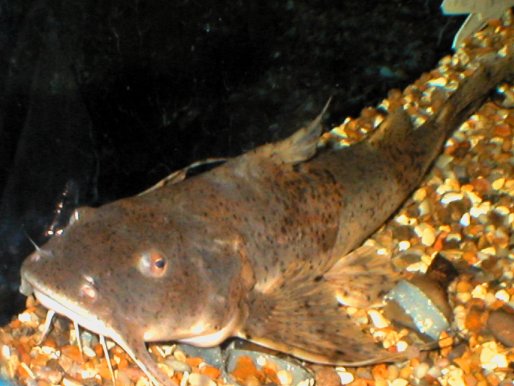
Bagarius bagarius - head view
I have personally been looking after (above) one of these magnificent catfish for the past year now and am just waiting for its owner to collect it before it outgrows its present accommodation. I am quite a fan of large catfish as I am sure that those of you who know me appreciate, the problem being the eventual size that this fish can attain…I really cannot accommodate a fish that might eventually grow to 200cm (or around 79" in old money). That said I am pleased that I have been able to observe this fish over the last few months. This fish has evil written all over its face, it watches every move that I make whilst in the fish house, and no matter where you are you can sense this fish watching you. It is a fish that does not like to be watched whilst it feeds, so you have to try to be out of eye-shot in order to see it feed. Very much a predator in its natural environment, it will however, take dead foods in captivity. At present this fish eats almost anything on offer including cockles, whole prawns, mussels, dead fish and large earthworms. It is for this reason that this catfish leads a solitary life, as I would not risk housing any other fish with it.
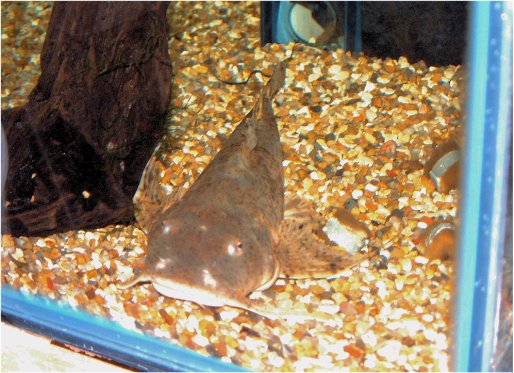
Bagarius bagarius
When keeping the Devil Catfish it is essential to provide the fish with oxygen-rich water due to the fact that these fish are from highland streams. I have personally found it essential to provide good filtration and water movement in order to keep this fish in optimum condition. Regular 25% water changes are also appreciated by this catfish, and I always carry these changes out weekly and certainly no longer than fortnightly. Other water parameters such as pH and hardness are not as important as good water circulation and aeration, but nevertheless are still of importance. I have found that this catfish will tolerate lower water temperatures than most other species of catfish due to the fact that its natural environment is cooler. At present the Bagarius that I have is kept at around 22ºC. I have to admit that this is a magnificent catfish to observe, but be warned that they will eat anything small enough to fit inside the enormous mouth that they possess. Finally perhaps it is just as well that these fish are rare amongst catfish imports, as in the wrong hands it could do untold damage to other fish and rapidly outgrow small accommodation. Remarks: As of January 2021 there are now five Bagarius species described. The "Devil Catfish" Bagarius bagarius from the Indian subcontinent. The "Dwarf Goonch" B. vegrandis is found in Chao Phraya and the Mekong. The "Flat head Goonch" B. suchus is found in Chao Phraya and the Mekong. The Giant B. lica is found in every basin except Salween. B. rutilis from Vietnam, and the undescribed species B. sp. salween which is only found in Salween. B. yarrelli is now a synonym of Bagarius bagarius.
|
 his month we welcome back regular contributor and
writer for the U.K. magazine 'Practical Fishkeeping',
Chris Ralph, with another feature on his favourite
topic " The Big and Nasty" with an
indeph look at the Devil Catfish from the Indian continent,
Bagarius bagarius. I will let Chris carry on and
hopefully educate and entertain you.
his month we welcome back regular contributor and
writer for the U.K. magazine 'Practical Fishkeeping',
Chris Ralph, with another feature on his favourite
topic " The Big and Nasty" with an
indeph look at the Devil Catfish from the Indian continent,
Bagarius bagarius. I will let Chris carry on and
hopefully educate and entertain you.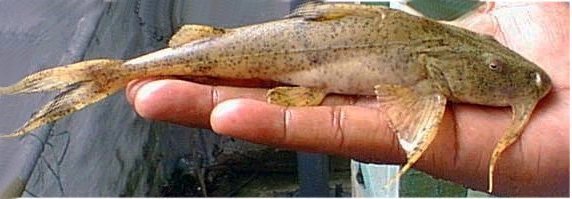
Common Name: |
Synonyms: |
Pimelodus bagarius, Bagarius yarellii, Bagarius lica, Bagarius buchanani |
Family: |
Sisoridae |
Subfamily: |
- |
Distribution: |
Asia: Ganges, Mekong and Chao Phraya basins. Reported from Salween, Maeklong and Peninsular Thailand. Type Locality: Ganges River, India. |
Size: |
90.0cm. (36ins) |
Temp: |
18-25°c (64-77°f.) |
p.H. |
6.5-7.8 although it is documented that pH 7.0 is optimum. |
Hardness |
It is documented that juvenile specimens prefer a hardness up to 12ºdGH, but that adult fish can tolerate a hardness of up to 30ºdGH. |
Characteristics |
Dorsal 1/6; Anal 12-15; Pectoral 1/13; Ventral 6. Four pairs of barbels: one pair each of of maxillary, nasal and two of mandibular; maxillary barbels with broad bases. Gill membranes free from each other up to base of isthmus and overlapping, free from isthmus. Caudal fin deeply forked, upper lobe longer and both lobes produced into soft filamentous prolongations. Lateral line complete, simple. Air-bladder small, enclosed in two bony capsules. |
Colouration |
This catfish is quite attractively marked. The base colour of the body of this fish is light brown with dark brown to black mottled markings over the eyes, around the dorsal and adipose fins and at the base of the caudal peduncle. The fins share this mottled pattern of markings. |
Aquarium Care & Compatibility |
| This really is a fish destined to live a solitary life due to the fact that I am convinced that it would eat just about any other occupant that it could fit inside its mouth. |
Reproduction |
There are no known records of this catfish having been bred in captivity, most likely due to their adult size and size of aquarium/tropical pond required for them. |
Sexual differences |
There are no documented or observed external sexual differences. |
Diet |
| As its common name suggests this truly is a demon amongst the fish world, requiring meaty foods at all times. In the wild this fish would predate upon smaller fishes, but in an aquarium it can be persuaded to feed upon cockles, mussels, whole prawns, dead fish and earthworms. It is also documented that this catfish when kept with fish bigger than itself, that it would eat their scales. |
Etymology |
| Bagarius: From the vernucular name; 'Vaghari' |
References |
Baensch,
H.A. and R. Riehl 1985 Aquarien atlas. Band
2. Mergus, Verlag für Natur- und Heimtierkunde
GmbH, Melle, Germany. 1216 p. |
Photo Credits |
Top picture:
© Asian Exports |
|

If you would like to contribute to the monthly factsheets with an
article, information or photos, please e-mail
me. You will of course be credited for your work.
If you would like to donate any denomination of money to the site just click the above link button. All proceeds will go to running the site and hopefully to keep it going for a few years yet.
ScotCat Sources
 Article
 Etymology-genera
Online Sources
 Search
 Fishbase
 Wikipedia
 Catalog of Fishes
 GBIF
GBIF
 Fishnet2
 iNaturalist

