SCOTCAT.COM
your internet guide to all things catfish
Bagarius vegrandis Ng & Kottelat, 2021 |
Image contributors to this species: |
Ben Lee (2) Pier Aquatics (1) |
ScotCat Sources: |
|

Other Sources: |
|


Relevant Information: |
Description: Bagarius vegrandis is a new species (2021), described from the Chao Phraya and Mekong river drainages. It differs from congeners in having a small maximum body size (to 220 mm SL vs. 520–1400 mm SL) and the adipose-fin origin markedly posterior to (vs. at vertical through or very slightly posterior to) the anal-fin origin. It further differs from congeners in having the following unique combination of characters: ovoid unculiferous plaques on dorsal surface of head, lateral margin of frontal not significantly deflected dorsally, eye diameter 11–15% HL, interorbital distance 23–28% HL, head width 18.3–22.3% SL, head depth 11.1–14.1% SL, filamentous extensions to first pectoral-fin element reaching to anus, dorsal spine width 10.6–13.9 times in its length, body depth at anus 8.7–12.0% SL, neural spines of the 4–6 vertebrae immediately anterior to adipose fin distally flattened but not forming series of prominent bumps along dorsal midline, length of adipose-fin base 10.8–13.0% SL, caudal-peduncle length 19.0–22.4% SL, caudal-peduncle depth 3.2–4.2% SL, 19–20 preanal vertebrae, and 39–40 total vertebrae. Bagarius bagarius (Hamilton, 1822) is demonstrated to be a species restricted to the Indian subcontinent (with Bagrus yarrelli Sykes, 1839, Pimelodus platespogon Valenciennes, in Jacquemont, 1839 and Pimelodus carnaticus Jerdon, 1849 as junior subjective synonyms) and Bagarius lica Volz, 1903 resurrected from synonymy with B. yarrelli as a valid species from Southeast Asia (NG & Kottelat (2021). Aquarium Care: Although this is the smallest of this genus it is really a fish destined to live a solitary life due to the fact that it would eat just about any other occupant that it could fit inside its mouth. Diet: In the wild this fish would predate upon smaller fishes, but in an aquarium it can be persuaded to feed upon cockles, mussels, whole prawns, dead fish and earthworms. It is also documented that this catfish when kept with fish bigger than itself, that it would eat their scales. Etymology: The specific name vegrandis: Latin for little or diminutive (authors sat “not very large”), referring to its small body size (up to 215.8 mm) compared with congeners. Remarks: As of January 2021 there are now five Bagarius species described. The "Devil Catfish" Bagarius bagarius from the Indian subcontinent. The "Dwarf Goonch" B. vegrandis is found in Chao Phraya and the Mekong. The "Flat head Goonch" B. suchus is found in Chao Phraya and the Mekong. The Giant B. lica is found in every basin except Salween. B. rutilis from Vietnam, and the undescribed species B. sp. salween which is only found in Salween and is now described as B. protos.. B. yarrelli is now a synonym of Bagarius bagarius. Update: As of June 2025 there are another two species described by Yang & Chen, B. protos (B. sp. "salween") and B. dolichonema bringing the total to seven. |
Common Name: |
Dwarf Goonch |
Synonyms: |
None |
Family: |
Sisoridae |
Distribution: |
Asia: Chao Phraya and Mekong river drainages. |
Size: |
20.0cm. (8ins) |
Temp: |
18-25°c (64-77°f.) |
p.H. |
|
6.5-7.8. |
IUCN Red List |
Bagarius vegrandis has most recently been assessed for The IUCN Red List of Threatened Species in 2022. Bagarius vegrandis is listed as Least Concern. (IUCN 2022). |
Reference: |
Ng, H. H, Kottelat,
M. 2021. Description of Bagarius vegrandis,
a new species of sisorid catfish from Indochina (Actinopterygii:
Siluriformes), with notes on the identity of Bagarius
bagarius. |

Family: Sisoridae Back to Ident-A-Cat Click on Thumbnails |
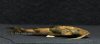 Bagarius vegrandis
 |
 Bagarius
vegrandis Bagarius
vegrandisHead view |
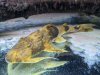 Bagarius
vegrandis Bagarius
vegrandis |
If you would like to contribute to the monthly factsheets with an article, information or photos, please e-mail me. You will of course be credited for your work.

If you would like to donate any denomination of monies to the site just click the above link button. All proceeds will go to running the site and hopefully to keep it going for a few years yet.

