SCOTCAT.COM
your internet guide to all things catfish
Bagarius bagarius (Hamilton, 1822) |
Image contributors to this species: |
Asian Exports (1) Paul Tapley (3) Chris Ralph (1) Peter Petersen (1) Nonn Panitvong (1) Johnny Jensen's Photographic Library (2) Allan James (2) |
ScotCat Sources: |


Other Sources: |


Relevant Information: |
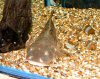
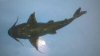
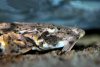
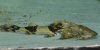
Description: Dorsal spines (total): 1; Dorsal soft rays (total): 6 - 6; Anal soft rays: 13 - 14; Vertebrae: 38 - 42. Pelvic-fin origin in front of the base of the last dorsal ray; adipose-fin origin behind the anal-fin origin. Elongate neural spines 4-8, distally expanded abdominal vertebrae 17-20. Absence of sharp ridge on top of head; absence of bumps on dorsal mid-line behind dorsal fin base. Mouth large, inferior and arciform. Inhabits rapid and rocky pools of large and medium-sized rivers and feeds on insects, small fishes, frogs and shrimps. Reproduction: Breeds in rivers prior to the beginning of the annual flood season. Marketed fresh. Important as a food fish, but the meat spoils rapidly and can cause illness. Aquarium Care: This really is a fish destined to live a solitary life due to the fact that it would eat just about any other occupant that it could fit inside its mouth. When keeping the Devil Catfish it is essential to provide the fish with oxygen-rich water due to the fact that these fish are from highland streams. I have personally found it essential (Ralph. 2002) to provide good filtration and water movement in order to keep this fish in optimum condition. Regular 25% water changes are also appreciated by this catfish, and I always carry these changes out weekly and certainly no longer than fortnightly. Diet: As its common name suggests this truly is a demon amongst the fish world, requiring meaty foods at all times. In the wild this fish would predate upon smaller fishes, but in an aquarium it can be persuaded to feed upon cockles, mussels, whole prawns, dead fish and earthworms. It is also documented that this catfish when kept with fish bigger than itself, that it would eat their scales. Etymology: The specific name bagarius: Derived, per Hamilton, from vaghari, Bengali name for this catfish in India; other regional names include baghari, baghaar, baghar, bihar and vaghair. Remarks: As of January 2021 there are now five Bagarius species described. The "Devil Catfish" Bagarius bagarius from the Indian subcontinent. The "Dwarf Goonch" B. vegrandis is found in Chao Phraya and the Mekong. The "Flat head Goonch" B. suchus is found in Chao Phraya and the Mekong. The Giant B. lica is found in every basin except Salween. B. rutilis from Vietnam, and the undescribed species B. sp. salween which is only found in Salween and is now described as B. protos.. B. yarrelli is now a synonym of Bagarius bagarius. Update: As of June 2025 there are another two species described by Yang & Chen, B. protos (B. sp. "salween") and B. dolichonema bringing the total to seven. |
Common Name: |
Devil Catfish |
Synonyms: |
Pimelodus bagarius, Bagarius yarellii, Bagarius lica, Bagarius buchanani |
Family: |
Sisoridae |
Distribution: |
Asia: Ganges, Mekong and Chao Phraya basins. Reported from Salween, Maeklong and Peninsular Thailand. Type Locality: Ganges River, India. |
Size: |
90.0cm. (36ins) |
Temp: |
18-25°c (64-77°f.) |
p.H. |
|
6.5-7.8. |
IUCN Red List |
Bagarius bagarius is harvested heavily throughout much or all of its range. This species has been extirpated in some rivers and, based on information from the Brahmaputra River drainage, is estimated to have undergone a decline of at least 30% over the last 30 years throughout its entire range. The status of the species, as it is currently understood, is assessed as Vulnerable under criterion A2d. (IUCN 2022). |
Reference: |
Baensch, H.A. and R.
Riehl 1985 Aquarien atlas. Band 2. Mergus,
Verlag für Natur- und Heimtierkunde GmbH, Melle,
Germany. 1216 p. |

Family: Sisoridae Back to Ident-A-Cat Click on Thumbnails |
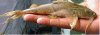 Bagarius bagarius
 |
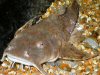 Bagarius
bagarius Bagarius
bagarius |
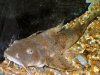 Bagarius
bagarius Bagarius
bagarius |
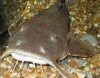 Bagarius
bagarius Bagarius
bagarius |
 Bagarius
bagarius Bagarius
bagarius |
 Bagarius
bagarius Bagarius
bagariusDorsal view |
 Bagarius
bagarius Bagarius
bagarius |
 Bagarius
bagarius Bagarius
bagariusHead view |
 Bagarius
bagarius Bagarius
bagarius |
 Bagarius
bagarius Bagarius
bagariusHead view |
If you would like to contribute to the monthly factsheets with an article, information or photos, please e-mail me. You will of course be credited for your work.

If you would like to donate any denomination of monies to the site just click the above link button. All proceeds will go to running the site and hopefully to keep it going for a few years yet.

