SCOTCAT.COM
your internet guide to all things catfish
Bagarius lica (Volz, 1903) |
Image contributors to this species: |
Frants Lehmann (1 Stamp) Jean-Francois Helias (4) |
ScotCat Sources: |
|

Other Sources: |


Relevant Information: |
Description: Mainly due to the presence of only 12 anal gland rays and differing due to other body proportions. Body elongated, belly flattened in the front half. Head strongly depressed. Body height 5 times in the total length without tail and almost 8 times with the caudal fin (without the lengthening of the upper lobe). The greatest height of the head is almost always contained in the distant tip of the nose and the end of the occipital processer Length of the head sometimes in the length of the body without the caudal filaments. Eyes very small, elongated; their diameter amounts to the entire length of the head, they lie exactly in the middle between the front and rear end of the head (with the occipital process distance between the two eyes about 1/16th diameter of the eye. Head bony above, in the middle somewhat sunk in the occipital process a little over the back of the the end of the gill protrudes, but not as far as the basal plate in front of the dorsal, twice as long as the width of its base. Muzzle depressed, rounded in front. Upper jaw protruding significantly above the lower in both jaws numerous, multi-row and of different sizes. Front nostril open, deadly, back covered by a flap-like skin, which forms the base of the very short nasal barbel. The latter has the rings of the smaller eye diameter, maxillary barbel stiff, very broad at the base, successively narrowed towards the end. Spines of the dorsal fin are strong and finely serrated, smooth at the back, lengthened upwards into a filament. Aquarium Care: This really is a fish destined to live a solitary life due to the fact that it would eat just about any other occupant that it could fit inside its mouth. When keeping the Devil Catfish it is essential to provide the fish with oxygen-rich water due to the fact that these fish are from highland streams. I have personally found it essential (Ralph. 2002) to provide good filtration and water movement in order to keep this fish in optimum condition. Regular 25% water changes are also appreciated by this catfish, and I always carry these changes out weekly and certainly no longer than fortnightly. Diet: As its common name suggests this truly is a demon amongst the fish world, requiring meaty foods at all times. In the wild this fish would predate upon smaller fishes, but in an aquarium it can be persuaded to feed upon cockles, mussels, whole prawns, dead fish and earthworms. It is also documented that this catfish when kept with fish bigger than itself, that it would eat their scales. Note: B. lica was a synonym of Bagarius yarrelli (Sykes 1839) which in itself is now a synonym of B. bagarius (2021). Still appearing on most online sources as B. yarrelli. Etymology: The specific name lica: Apparent latinisation of lika, Malay name for this catfish in Sumatra. Remarks: As of January 2021 there are now five Bagarius species described. The "Devil Catfish" Bagarius bagarius from the Indian subcontinent. The "Dwarf Goonch" B. vegrandis is found in Chao Phraya and the Mekong. The "Flat head Goonch" B. suchus is found in Chao Phraya and the Mekong. The Giant B. lica is found in every basin except Salween. B. rutilis from Vietnam, and the undescribed species B. sp. salween which is only found in Salween and is now described as B. protos.. B. yarrelli is now a synonym of Bagarius bagarius. Update: As of June 2025 there are another two species described by Yang & Chen, B. protos (B. sp. "salween") and B. dolichonema bringing the total to seven. |
Common Name: |
Devil Catfish |
Synonyms: |
None |
Family: |
Sisoridae |
Distribution: |
Asia: Southeast Asia. |
Size: |
150.0cm. (5ft 0ins) |
Temp: |
18-25°c (64-77°f.) |
p.H. |
|
6.0-7.2. |
IUCN Red List |
Although B. lica has been extirpated on Java, and subpopulations in the upper Mekong River drainage may be adversely impacted by hydropower dams, there are no threats affecting this species on a range-wide scale. Furthermore, it is found within several protected areas. Therefore, it is assessed as Least Concern (IUCN 2022). |
Reference: |
Neue Fische aus Sumatra,
Volz, 1903. Zoologischer Anzeiger. |

Family: Sisoridae Back to Ident-A-Cat Click on Thumbnails |
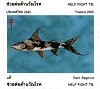 Bagarius
lica Bagarius
licaStamp |
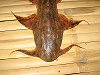 Bagarius
lica Bagarius
licaHead dorsal view |
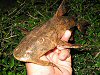 Bagarius
lica Bagarius
lica |
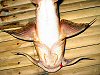 Bagarius
lica Bagarius
licaVentral view |
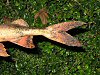 Bagarius
lica Bagarius
licaTail pattern |
If you would like to contribute to the monthly factsheets with an article, information or photos, please e-mail me. You will of course be credited for your work.

If you would like to donate any denomination of monies to the site just click the above link button. All proceeds will go to running the site and hopefully to keep it going for a few years yet.

