SCOTCAT.COM
your internet guide to all things catfish
Bagarius rutilus Ng & Kottelat, 2000 |
Image contributors to this species: |
Zhou Hang (1) Sablegsd (1) Jorge Garcia (1) |
ScotCat Sources: |
|

Other Sources: |


Relevant Information: |
Description: Conspicuous by the yellow/pale orange fins. Dorsal spines (total): 1; Dorsal soft rays (total): 6; Anal soft rays: 12 - 13; Vertebrae: 42 - 43. Can be differentiated from its congeners in the combination of following characters: skin heavily keratinized, cranium and interneural covered with numerous large, elongate tubercles, supraoccipital and interneural without sharp ridges, skin above neural spines anterior and posterior to adipose fin never forming distinct ridges, slender elongate neural spines, elliptical eyes, body depth at anus 11.0-12.3 %SL, head width 20.3-21.7 %SL, snout length 51.4-54.7 %HL, eye diameter 4.1-8.1 %HL; 12-13 pectoral-fin rays; caudal fin with 8-9 rays; 23-24 preanal vertebrae; adipose fin with short base and angular dorsal margin. Adipose origin in front or above anal fin origin; longitudinal diameter of eye 12-24 times in HL. Colouration: Dark yellow on dorsal and lateral surfaces of head and body, fading to light yellow on ventral region; dorsal surfaces of head and body with three darkly pigmented (brown) bands or blotches; a few small brown spots irregularly distributed throughout lighter parts of body; light yellow fins with a variable pattern of small brown spots distributed irregularly, orange fins in life. Aquarium Care: This really is a fish destined to live a solitary life due to the fact that it would eat just about any other occupant that it could fit inside its mouth. Provide good filtration and water movement in order to keep this fish in optimum condition. Regular 25% water changes are also appreciated by this catfish, and carry these changes out weekly and certainly no longer than fortnightly. Diet: This truly is a demon amongst the fish world, requiring meaty foods at all times. In the wild this fish would predate upon smaller fishes, but in an aquarium it can be persuaded to feed upon cockles, mussels, whole prawns, dead fish and earthworms. Etymology: The specific name rutilis: Latin for red, golden red or reddish yellow, referring to orange fins in life and to type locality (Red River, Vietnam). Remarks: As of January 2021 there are now five Bagarius species described. The "Devil Catfish" Bagarius bagarius from the Indian subcontinent. The "Dwarf Goonch" B. vegrandis is found in Chao Phraya and the Mekong. The "Flat head Goonch" B. suchus is found in Chao Phraya and the Mekong. The Giant B. lica is found in every basin except Salween. B. rutilis from Vietnam, and the undescribed species B. sp. salween which is only found in Salween and is now described as B. protos.. B. yarrelli is now a synonym of Bagarius bagarius. Update: As of June 2025 there are another two species described by Yang & Chen, B. protos (B. sp. "salween") and B. dolichonema bringing the total to seven. |
Common Name: |
None |
Synonyms: |
Bagarius bagarius (non Hamilton, 1822), Bagarius yarrelli (non Sykes, 1839). |
Family: |
Sisoridae |
Distribution: |
Asia: Nam Xam and Nam Ma basins in Laos and Red River (song hong) basin in Viet Nam and Yunnan, China. |
Size: |
100.0cm. (40ins) |
Temp: |
18-25°c (64-77°f.) |
p.H. |
|
6.5-7.5. |
IUCN Red List |
Bagarius rutilus has most recently been assessed for The IUCN Red List of Threatened Species in 2011. Bagarius rutilus is listed as Data Deficient, (IUCN 2012). |
Reference: |
Allen, D.
2012. Bagarius rutilus. The IUCN Red List
of Threatened Species 2012. |

Family: Sisoridae Back to Ident-A-Cat Click on Thumbnails |
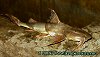 Bagarius
rutilus
Bagarius
rutilus |
 Bagarius rutilus
 |
 Bagarius
rutilus Bagarius
rutilus |
If you would like to contribute to the monthly factsheets with an article, information or photos, please e-mail me. You will of course be credited for your work.

If you would like to donate any denomination of monies to the site just click the above link button. All proceeds will go to running the site and hopefully to keep it going for a few years yet.

