SCOTCAT.COM
your internet guide to all things catfish
FACTSHEETS: December 2009 - no. 162
Mystus tengara (Hamilton, 1822) |
Mystus tengara
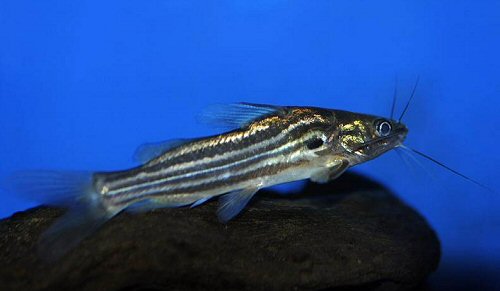
Since its description in 1822 from “Ponds of India”, by Hamilton-Buchanan, M. tengara has been discussed as being very similar to or perhaps a junior synonym of M. vittatus. The original drawing of Mystus tengara shows the structure of the fontanel and supraoccipital process being very similar to M.vittatus. (Grant 2006). If the drawings of both species are correct (Jayaram 2006) M.tengara has a longer lower adipose fin. M.tengara has the five longitudinal body stripes also paler than M.vittatus. Often mistaken for the smaller M. carcio and M. vittatus but vittatus has a longer median groove and the stripes are more prominent. It has also a low head and body and M. tengara occurs mostly in the northern parts of India. There is still a lot of work to be carried out on this genera although Ng and Ferraris (2000) segregated Hemibagrus to accommodate five species of Mystus and described two others. You can understand this move as Hemibagrus are superficially different in body shape, and from the layman's view, they are flat headed, large and extremely aggressive.
Mystus vittatus - notice the smaller adipose fin
There is even conflicting information on the length of the maxillary barbels on M.vittatus as Jayaram (2006) states "maxillary pair reaching base of pelvic fin" and Munro (1955) "maxillaries reaching middle of anal" (Macrones vittatus). So as you can see there is a fair bit of work still to do, especially concerning the striped Mystus spp. Mystus tengara It is found in flowing and standing waters. Adults inhabit rivers and ponds in plains and submountain regions. Apart from the confusion on this Bagrid...how do we keep it in the aquarium?. Not a problem as long as you keep four or more as they will do better in a group. This is quite a small Bagrid but never the less it is better to keep species with them that are around about the same size, for after all they are from the Bagridae family and most (but not all) can be predatory. Furnish the aquarium with driftwood for hiding places and plants. Substrate is a personal choice.
|
 here are differing views on the true identity of this
species from the Bagridae family as it may in the
future turn out to be a junior synonym of
here are differing views on the true identity of this
species from the Bagridae family as it may in the
future turn out to be a junior synonym of 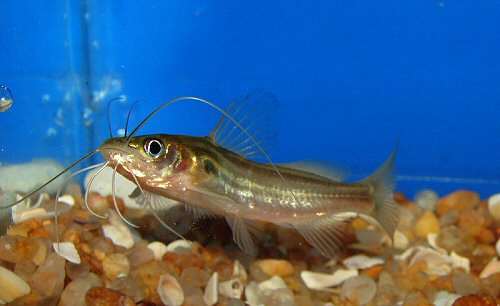
Common Name |
Pyjama catfish |
Synonyms |
Macrones tengara, Mystus tengra, Pimelodus carcio, Pimelodus tengara |
Family |
Bagridae |
Subfamily |
- |
Distribution |
Asia: Pakistan, India, Nepal and Bangladesh. Reported from Afghanistan. |
Size |
10.0cm. (4ins) |
Temp. |
22-28°C (71-83°F) |
p.H. |
6.5-7.2 |
Characteristics |
Median longitudinal groove on head reaching base of occipital process. Occipital process three times as long as broad at base and reaching basal bone of dorsal fin. Teeth villiform, numerous in a continuous band on palate and upper jaw; in a mesially interrupted deeply curved band on lower jaw. Four pairs of barbels; maxillary pair extending to base of anal fin, nasal anterior end of opercle, outer mandibular base of pectoral fin and inner pair short. Rayed dorsal fin inserted above half of pectoral fin, spine strong, outer surface smooth, inner surface with 8-10 retrorse teeth. Pelvic fin not reaching anal fin. Anal fin not reaching caudal fin base. Least depth of caudal peduncle 1.5 to 1.8 in its length. Caudal fin forked, upper lobe longer than lower. |
Colouration |
Light brown on top turning dull yellow on sides and beneath. About five parallel longitudinal stripes on either side of body present. Occasionally a dark shoulder spot may also be seen. |
Aquarium Care & Compatibility |
| Will do well in your medium to large aquarium with larger Tetra type fish and Barbs. Keep at least 4 in a group as they are happier interacting with each other. |
Reproduction |
Not reported but oviparous, distinct pairing possibly like other members of the same family. This genus is known to be egg scatterers and may eat the eggs if they are not separated. Cold water changes may start a pair off if they are kept in a species tank on their own. There have been a couple of instances of successfull breeding attempts with Mystus species, notably M. armatus and M. vittatus. |
Sexual differences |
Males have an elongate genital papilla in front of the anal fin. Females will be fuller bodied. |
Diet |
| Flake food which will give them all the vitamins they desire. They should of course be fed a varied diet consisting of the former, tablet, pellet foods and frozen foods such as bloodworm. |
Glossary of Terms |
Mandibular:
Pertaining to the lower jaw. (mandibular barbels). |
Etymology |
| Mystus
from “mystax”
meaning whiskered or moustache (hair on the upper
lip). Mystus was first used by Belon in 1553 to describe
all fish with whiskers. |
References |
Froese,
R. and D. Pauly.
Editors. 2009. FishBase. World Wide Web electronic publication.
www.fishbase.org, version (07/2009). |
Photo Credits |
Top: © Hayath
|

|

If you would like to contribute to the monthly factsheets with an
article, information or photos, please e-mail
me. You will of course be credited for your work.
If you would like to donate any denomination of money to the site just click the above link button. All proceeds will go to running the site and hopefully to keep it going for a few years yet.
ScotCat Sources
 Article
 Etymology-genera
Etymology-specific name
Online Sources
 Search
 Fishbase
 Catalog of Fishes
 GBIF
GBIF
 Fishnet2
 iNaturalist

