SCOTCAT.COM
your internet guide to all things catfish
FACTSHEETS: June 2003 - no. 084
Noturus gyrinus (Mitchill, 1817) |
Noturus gyrinus
There is quite an abundance of information sheets and articles on this species on the internet but I do not apologize for adding to this total as we can never get enough (factual) information on any given catfish species as we strive to glean as much knowledge as we can on these fascinating creatures. The name Noturus means "back tail" and refers to the fusion of the adipose and caudal fins ( in some species ) which tends to give them a tadpole-like appearance. The "Tadpole Madtom" is one of the smallest Madtoms apart from the rarest; Noturus stanauli, is abundant in strong riffles of large creeks and rivers, especially in areas having boulders or large flat rocks. It is one of the most widespread species in the genus and can be found from South West Quebec and South East Manitoba in Canada down to Southern Florida and Texas. It is absent in the Appalachian Mountains.
Noturus gyrinus
You must be very aware of the poison gland in this genus which resides in the base of the dorsal and pectoral fins as it can give you a very sore hand, so you will have to be careful if catching or moving these fish. Noturus gyrinus can be found in a variation of body colorations and body shape. Taylor (1969:48-49) believed the variation in form is a function of nutrition during growth. There are of course a few aquarists here in the U.K. who are coldwater cat enthusiasts but they are getting few and far between due to to the import restrictions on this family of cats. There is now moves afoot by the Government ( U.K.) through the Ministry of Agriculture, Fisheries and Food (MAAF) to impose restrictions on some coldwater species like the above mentioned 'Stonecat', due to the dangers of introduction to native waters and the threat to its occupants through disease and predation. In other words you could be paying up to £30 for a license to keep them. In the future due to the exporters having to implement new guidelines on matters such as health records for each fish, they could become quite rare in the U.K. It is a pity as
I would have loved to have tried out the "madtoms"
as something different here in the U.K. but you can
see the problem it may cause if they are released
into our waters by uncaring "aquarists"
and the damage to our already fragile ecosystem.
|
 t is nearly two years now since I last featured any
catfish from the North American continent (
t is nearly two years now since I last featured any
catfish from the North American continent (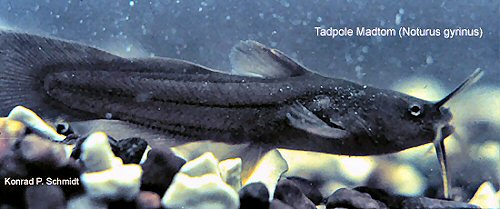
Common Name |
Tadpole Madtom |
Synonyms |
Silurus gyrinus |
Family |
Ictaluridae |
Subfamily |
- |
Distribution |
North America: Atlantic draining Rivers, below Fall line; Mississippi River basin; rivers draining Gulf of Mexico (north of Rio Grande); and Great Lakes; introduced into many additional rivers. Type locality: Wallkill, New York. |
Size |
11.5cm. (4½ins) |
Temp. |
05-23°C (37-73°F) |
p.H. |
6.5-7.0 |
Characteristics |
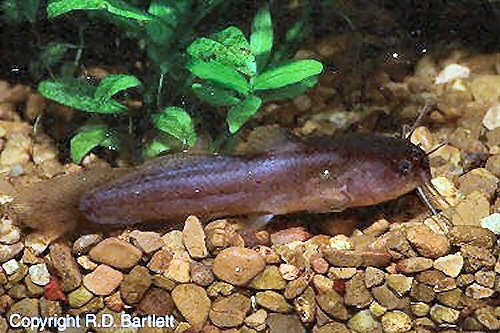
Tadpole shaped, robust anteriorly, strongly compressed posteriorly. Head deep, rounded above; eye small; mouth terminal; 4 pairs of barbels. Pectoral fin spine lacks serrations, has poison gland at base. Adipose fin continues with broad rounded caudal fin. |
Colouration |
Reddish, tan or dark brown above with one or two dark axial stripes along each side. Belly yellowish; median fins olive. |
Aquarium Care & Compatibility |
| In common with most of this genus they make good inhabitants of a cold (cool) water aquarium and can be mixed with other cool water species such as shiners, minnows and darters. They like to have place to call home in the aquarium so furnish it with rocks or driftwood and flat stones so they can hide during the day. You can have either sand or a mixed fine gravel and an internal power filter to gently push the water around the tank, this will imitate the conditions encountered in the wild for this species. |
Reproduction |
There has been a few spawning's in the aquarium, Warming the water up will possibly induce a spawning with a clutch of eggs laid under a flat surface or pipework. They can be left with the parents. The life expectancy is three to four years and they will be sexually mature in two years. |
Diet |
| They like most meaty food, such as cut-up earth worms, frozen blood worm and prawns. They will also take tablet and pellet foods. A varied diet will keep them in optimum health. |
Etymology |
| Noturus:
Meaning "Back Tail" referring to the fusion
of the adipose and caudal fins. |
IUCN Red List |
Listed as Least Concern in view of the large extent of occurrence, large number of subpopulations, large population size, and lack of major threats. Trend over the past 10 years or three generations is uncertain but likely relatively stable, or the species may be declining but not fast enough to qualify for any of the threatened categories under Criterion A (reduction in population size), (needs updating IUCN 2013). |
References |
Knopf,
The Audubon Society Field guide to North America Fishes,
Whales & Dolphins, 1986. |
Photo Credits |
Top image: © Konrad
P. Schmidt from the The Native Fish Conservancy
at www.nativefish.org
|
|

If you would like to contribute to the monthly factsheets with an
article, information or photos, please e-mail
me. You will of course be credited for your work.
If you would like to donate any denomination of money to the site just click the above link button. All proceeds will go to running the site and hopefully to keep it going for a few years yet.
ScotCat Sources
 Article
 Etymology-genera
Etymology-specific name
Online Sources
 Search
 Fishbase
 Wikipedia
 Catalog of Fishes
 GBIF
GBIF
 Fishnet2
 iNaturalist
 IUCN
IUCN

