SCOTCAT.COM
your internet guide to all things catfish
FACTSHEETS: December 1997 - no. 018
Synodontis robertsi Poll, 1974 |
Synodontis robertsi
This species can be confused with the much larger Synodontis caudalis pictured below but the point to look out for in robertsi is the unusual large eyes similar to S. alberti, the bigger ornate pattern on the body and short barbels, while S. caudalis has smaller eyes, longer barbels, and also grows larger at 20cm SL, it can also be territorial when larger. S. robertsi has a deeply forked caudal fin similar to S. caudalis with the top lobe being slightly longer than the bottom lobe.
Synodontis
caudalis It is named in honour of Mr.Tyson R. Roberts of the Museum of Comparative Zoology, Harvard and was described by Poll in 1974 from a single specimen which was caught in the Lukenier River in the Democratic Republic of the Congo. The genus Synodontis sports three pairs of barbels 1pair: maxillary, 1 pair: outer mandibular and one pair of inner mandibular barbels that are branched (filaments). There are only three species that have filaments on their maxillary barbels as well as the mandibular, and they are, S. clarias, S. decorus and S. flavitaeniatiatus.
|
 his is not a very common Synodontis
in the hobby and if you find it in your local aquatic
outlets, and you are a fan of this genus, snap them
up!. Because of their relatively small size and peaceful
temperament they are a good candidate for a community
tank.
his is not a very common Synodontis
in the hobby and if you find it in your local aquatic
outlets, and you are a fan of this genus, snap them
up!. Because of their relatively small size and peaceful
temperament they are a good candidate for a community
tank.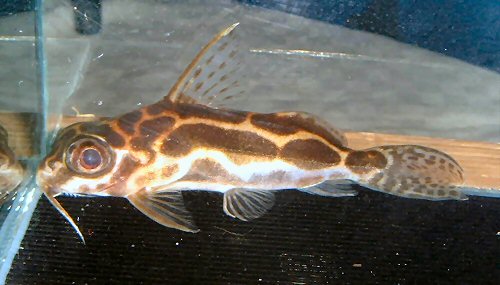

Common Name |
Roberts Catfish |
Synonyms |
None |
Family |
Mochokidae |
Subfamily |
Mochocinae |
Distribution |
Africa: Known from the type locality, River Lukenie, Central Democratic Republic of the Congo. |
Size |
7.5cm. (3ins) |
Temp. |
22-26c (72-80f ) |
p.H. |
6.2-7.5. |
Characteristics |
Skin non villose. Eye sublateral but not visible from below. Mouth small. Maxillary barbels with a thin mebrane (very distinct). Mandibular barbels with a short tubercular ramifications that are close together. Dorsal fin spine weakly serrated on anterior edge and strongly serrated on posterior edge. Pectoral fin spine strongly serrated on both edges. Adipose fin large with a long base. Caudal fin deeply forked with pointed lobes, the top being a bit longer. |
Colouration |
Ground colour of head and body dark whitish. Dorsal regions, including the adipose fin are covered with large black irregularly shaped blotches which are smaller on the head and snout. The whitish area between the blotches form a reticulated pattern. Ventral regions white. Dorsal and caudal fin rays with small dark spots forming bars (more pronounced in the caudal fin). Remaing fins clear. |
Aquarium Care & Compatibility |
| Synodontis robertsi is a very peaceful fish and a prime candidate for an average sized community tank. |
Reproduction |
Not recorded. |
Diet |
| The usual feeding for Synodontis species, being good quality flake food, tablet food, frozen bloodworm, shrimp and prawns. |
Etymology |
| Synodontis:
Syn = together; odontis = teeth
(fused tooth plates). |
References |
Northern Area Catfish Group; Information Sheet 48. |
Photo Credits |
Top
image: © Allan
James @ Bottom
image: © |


|

If you would like to contribute to the monthly factsheets with an article, information or photos, please e-mail me. You will of course be credited for your work.
If you would like to donate any denomination of money to the site just click the above link button. All proceeds will go to running the site and hopefully to keep it going for a few years yet.
ScotCat Sources
 Article
 Etymology-genera
Etymology-specific name
Other Sources
 Search
 Fishbase
 Wikipedia
 Catalog
of Fishes
Catalog
of Fishes
 GBIF
GBIF
 Fishnet2
 iNaturalist

