SCOTCAT.COM
your internet guide to all things catfish
FACTSHEETS: January 2026 - no. 355
Synodontis multipunctatus Boulenger, 1898 |
|
|
 e begin on another new year with one of my favourite
genus and probably one of the best known and written
about members of this genera, the "Cuckoo Synodontis",
Synodontis multipunctatus. It is well known,
of course, for its unusual breeding methods of laying
its eggs with host breeding Chichlids. There are many
colour forms from various parts of the lake with the
southern forms being a bit lighter in body colouration.
e begin on another new year with one of my favourite
genus and probably one of the best known and written
about members of this genera, the "Cuckoo Synodontis",
Synodontis multipunctatus. It is well known,
of course, for its unusual breeding methods of laying
its eggs with host breeding Chichlids. There are many
colour forms from various parts of the lake with the
southern forms being a bit lighter in body colouration.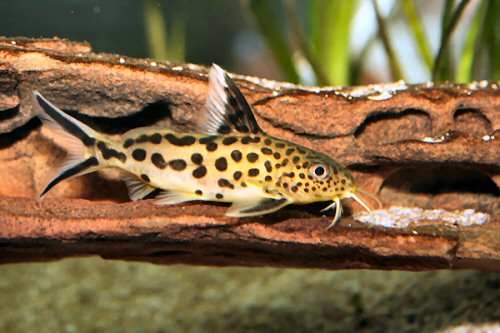
Common Name |
Cuckoo Synodontis |
Synonyms |
Synodontis grandiops, Synodontis multipunctata |
Family |
Mochokidae |
Subfamily |
Mochokinae |
Habitat |
Found fairly close to the shore but occur down to a depth of at least 160m (Coulter, 1991). As well as the type locality it can be found around the lake shores of the lake. |
Distribution |
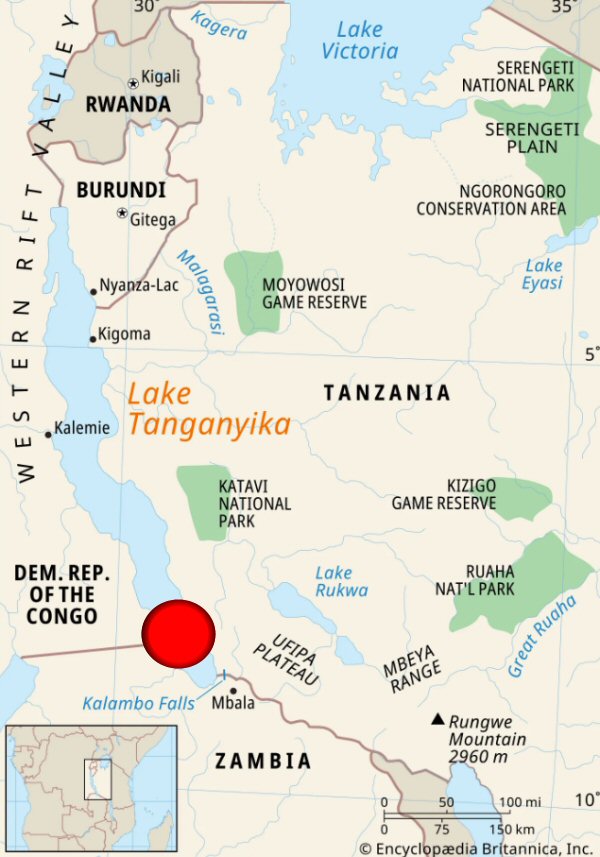
Africa: Found all around the shore line in Lake Tanganyika. Type locality: Lake Tanganyika, southern end of lake in The Dem.Rep. of Congo, near to the Zambian border. |
Size |
20.0cm. (8ins) |
Temp. |
23-25°C (73-77°F) |
p.H. |
7.2-8.2. |
Characteristics |
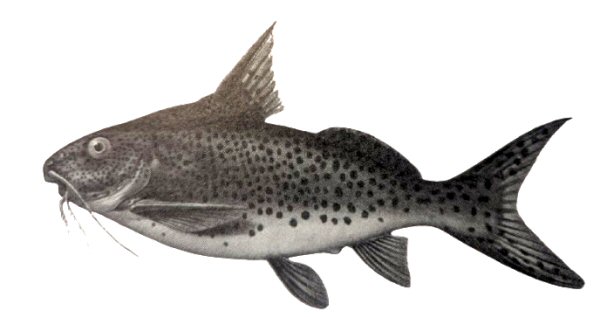
Dorsal spines (total): 2; Dorsal soft rays (total): 7; Anal spines: 0; Anal soft rays: 9 - 12. Axillary pore present; mandibular teeth 13-29; body with large spots; fin spines dark; 8 pectoral-fin rays; black triangles at base of pelvic and anal fins absent or poorly developed; eye 44.9-62.0% snout length; premaxillary toothpad uninterrupted; secondary branches on medial mandibular barbel absent; occipito-nuchal shield usually covered with skin; papillae on skin of body absent; hindgut chamber absent. Body shape (shape guide): fusiform / normal. |
Colouration |
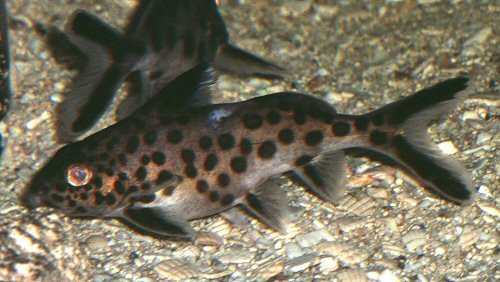
S. multipunctatus has a base body colour that is golden beige when young, but this seems to get darker with age. The body is covered with dark black blotches that are randomly strewn across the body and head. Pectoral, dorsal, and tail fins are black with a white margin, although the dorsal fin's white margin is only on the posterior of that fin. Their undersides are creamy white, as are their six barbels. |
Aquarium Care & Compatibility |
| Can be kept with Lake Tanganyika and Lake Malawi Cichlids. Best kept in groups in a medium to large tank. Alkaline water parameters are best for this and all Lake Tanganyika species. An efficient biological filtration is called for, as regular water changes are crucial to the well-being of this species. |
Reproduction |
Distinct pairing during breeding. Pairs manage to mix their eggs in the spawning nest of mouthbrooding cichlids, which take the eggs in their mouth together with their own. Its larvae grow faster than those of the host and when they absorb their own yolk sac they feed on the cichlid eggs and developing fry. This is, of course, a cuckoo spawner and as such is a "brood parasite". They received this name when it was discovered that they use mouth-brooding cichlids as a host for their eggs to hatch. There are two articles listed on the website for information on breeding this unique species see Article 24 and Article 29. |
Sexual differences |
Males have a somewhat higher dorsal fin with the females being more rotund. As with other Synodontis, in male fish it is possible to distinguish the genital papilla near the anus. |
Diet |
| All aquarium fish foods are taken, flake foods, tablet, pellet and frozen foods. In its natuarl habitat it is generally considered to be a predator of Neothauma tanganyicense, a common gastropod. |
Glossary of Terms |
Anal
fin: The median, unpaired,
ventrally located fin that lies behind the anus, usually
on the posterior half of the fish. |
Etymology |
| Synodontis:
From the Greek syn, meaning together,
and odontos, meaning tooth; in reference to the closely-spaced
lower jaw teeth. |